English
 Español
 tiếng việt
 русский
High thermal stability up to 250 °C continuous use temperature.
Excellent weather resistance and UV stability for long-term outdoor performance.
Good compatibility with organic resins, enabling hybrid formulation flexibility.
Low surface energy providing inherent water repellency and anti-soiling properties.
Self-crosslinking capability under heat or ambient moisture, reducing need for external catalysts.
High-performance protective coatings for façades and architectural concrete.
Water-repellent impregnations for natural stone, brick, and mortar substrates.
Binders in mineral-based renders and plasters requiring enhanced durability.
Hybrid systems combining silicone and acrylic or polyester resins for industrial finishes.
Additive in fire-retardant coatings to improve char integrity and thermal insulation.
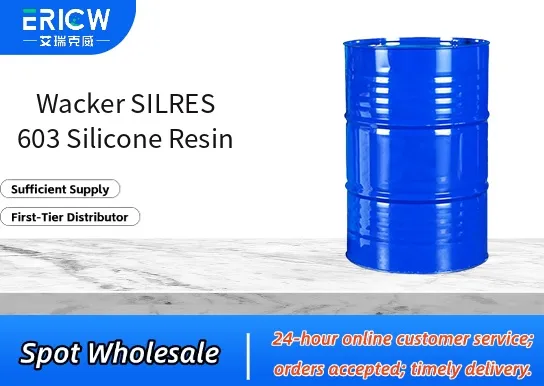
| Chemical Type | Methyl/phenyl silicone resin |
| Product Form | Liquid (solvent-based) |
| Appearance | Clear, colorless to pale yellow liquid |
| Solvent | Xylene / aromatic hydrocarbon mixture |
| Non-Volatile Content | Approx. 60 wt.% |
| Density (20 °C) | Approx. 0.92 g/cm³ |
| Viscosity (25 °C) | Approx. 15–25 mPa·s |
| Primary Applications | Protective coatings, mineral binder modification, water repellents |
Q1: What is the primary function of SILRES 603 in coating and ink formulations?
A: SILRES 603 is a methyl-phenyl silicone resin designed to enhance surface properties—particularly improving slip, mar resistance, and substrate wetting—without significantly affecting gloss or film transparency. It functions as a surface modifier that migrates to the air–film interface during drying/curing.
Q2: Is SILRES 603 compatible with common organic solvent-based systems?
A: Yes, SILRES 603 exhibits good compatibility with aromatic and aliphatic hydrocarbons, esters, ketones, and chlorinated solvents. It is generally not recommended for use in highly polar protic media such as water or low-molecular-weight alcohols without prior compatibility testing.
Q3: How should SILRES 603 be incorporated into a formulation?
A: It is typically added during the let-down stage under moderate agitation. Pre-dilution in a suitable solvent is recommended to ensure uniform dispersion. Avoid high-shear mixing that may induce premature surface segregation or foaming.
Q4: Does SILRES 603 contribute to thermal or UV stability in finished films?
A: As a phenyl-containing silicone resin, SILRES 603 imparts improved thermal stability and enhanced resistance to UV-induced degradation compared to purely methyl-based silicones—making it suitable for demanding exterior applications where long-term weatherability is required.
Contact With Us:
E-mail: wangxingqiang@ericwchem.com
Have a Questions? Call Us:
Add:
Building A1, Jiete Industrial Park, Huangpu District, Guangzhou City, Guangdong Province, China