English
 Español
 tiếng việt
 русский
High thermal stability with continuous use up to 200 °C
Excellent electrical insulation properties even under humid conditions
Good compatibility with organic resins and pigments for hybrid formulations
Low volatile content, supporting low-VOC and compliant coating systems
Enhanced weatherability and UV resistance for long-term outdoor performance
Heat-resistant coatings for industrial ovens and exhaust components
Electrical insulation varnishes for motors, transformers, and coil windings
High-performance release coatings for silicone-free mold surfaces
Weatherable topcoats for architectural metal cladding and façade systems
Binders in specialty ceramic and refractory coatings
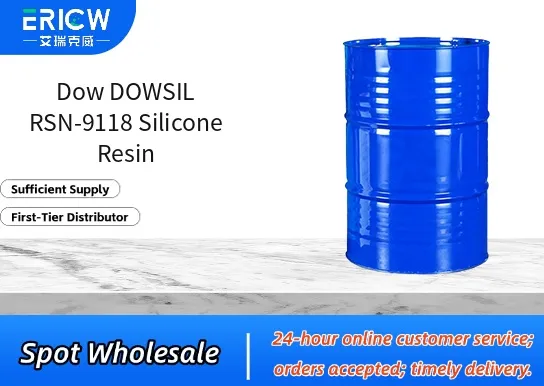
| Chemical Type | Methyl-phenyl silicone resin |
| Product Form | Clear to slightly hazy liquid |
| Appearance | Colorless to pale yellow, homogeneous liquid |
| Solvent Content | Xylene-based solution (~45–50% solids) |
| Viscosity (25 °C) | 800–1,200 cP |
| Specific Gravity (25 °C) | 0.96–0.99 g/cm³ |
| Flash Point (Tag Closed Cup) | 38–42 °C |
| Primary Applications | High-temperature protective coatings, electrical insulation, weather-resistant finishes |
Q1: What is the primary function of DOWSIL RSN-9118 in coating formulations?
A: DOWSIL RSN-9118 is a methyl-phenyl silicone resin designed to enhance thermal stability, weather resistance, and surface hardness in high-performance organic resin systems—particularly in heat-cured industrial coatings and ceramic-compatible topcoats.
Q2: Is DOWSIL RSN-9118 compatible with common organic binders such as acrylics, epoxies, or polyesters?
A: Yes, RSN-9118 exhibits good compatibility with a broad range of thermosetting resins when properly dispersed or pre-reacted. Compatibility testing under intended cure conditions is recommended to confirm film integrity and performance synergy.
Q3: How is DOWSIL RSN-9118 typically incorporated into a formulation?
A: It is generally added during the let-down or post-additive stage using high-shear mixing. Solvent selection (e.g., xylene, VM&P naphtha, or aromatic blends) should ensure full dissolution or stable dispersion prior to blending with other components.
Q4: Does RSN-9118 require catalysts or co-resins for effective crosslinking?
A: While RSN-9118 contains reactive silanol groups that can self-condense at elevated temperatures, its integration into hybrid systems often benefits from conventional curing agents (e.g., melamine-formaldehyde or blocked isocyanates), depending on the base resin and end-use requirements.
Contact With Us:
E-mail: wangxingqiang@ericwchem.com
Have a Questions? Call Us:
Add:
Building A1, Jiete Industrial Park, Huangpu District, Guangzhou City, Guangdong Province, China