English
 Español
 tiếng việt
 русский
Excellent transparency and gloss retention under UV exposure.
Superior weatherability and resistance to yellowing in outdoor applications.
Good melt flow characteristics for efficient extrusion and injection molding.
High impact strength combined with dimensional stability at elevated temperatures.
Compatible with common plasticizers and co-polymers for formulation flexibility.
Automotive exterior trim and lighting lenses.
Architectural glazing and transparent façade panels.
Consumer electronics housings requiring optical clarity and scratch resistance.
Medical device components requiring biocompatibility support and sterilization compatibility.
Signage and display materials exposed to long-term ambient conditions.
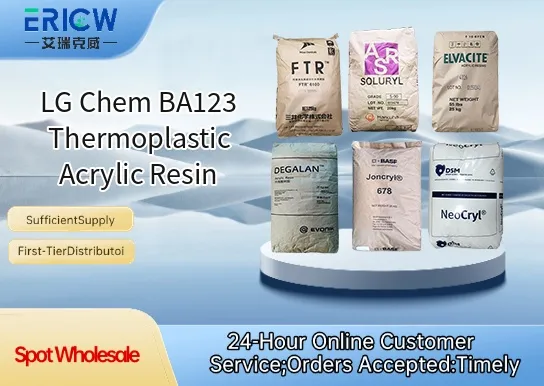
| Chemical Type | Thermoplastic acrylic copolymer |
| Product Form | Pellets |
| Appearance | White, free-flowing granules |
| Primary Applications | Extrusion, injection molding, thermoforming |
| Key Features | UV-stable, high-gloss, non-yellowing |
| Benefits | Reduced need for protective coatings; extended service life outdoors |
| Processing Temperature Range | 180–230 °C (melt processing) |
| Specific Gravity (ASTM D792) | 1.18–1.20 |
Q1: What are the primary processing methods suitable for LG Chem BA123?
A: LG Chem BA123 is designed for conventional thermoplastic processing techniques, including extrusion, injection molding, and solvent-based coating applications. Its thermal stability and melt flow characteristics support consistent performance in high-speed production environments.
Q2: How does BA123 contribute to surface hardness and gloss in coated substrates?
A: As a thermoplastic acrylic resin, BA123 enhances film-forming integrity and contributes to improved surface hardness, scratch resistance, and high-gloss finish—particularly when used in clear topcoats or decorative laminates on wood, metal, or plastic substrates.
Q3: Is BA123 compatible with common crosslinkers or reactive additives?
A: BA123 is inherently non-reactive and functions as a thermoplastic binder; it is not formulated for covalent crosslinking. However, it can be physically blended with certain melamine formaldehyde resins or blocked isocyanates in hybrid systems where thermoplasticity and partial thermal cure are both desired—compatibility must be verified experimentally per formulation.
Q4: What solvents are typically recommended for dissolving BA123 in coating formulations?
A: BA123 exhibits good solubility in common organic solvents such as methyl ethyl ketone (MEK), methyl isobutyl ketone (MIBK), toluene, and xylene. Solvent selection should consider evaporation rate, regulatory constraints, and compatibility with other formulation components.
Q5: Can BA123 be used in food-contact applications?
A: BA123 is not pre-approved for direct food-contact use. Any application involving potential food contact requires full regulatory assessment—including evaluation of migration behavior and compliance with applicable regional food contact material regulations—by the final formulator or end-user.
Contact With Us:
E-mail: wangxingqiang@ericwchem.com
Have a Questions? Call Us:
Add:
Building A1, Jiete Industrial Park, Huangpu District, Guangzhou City, Guangdong Province, China