English
 Español
 tiếng việt
 русский
Excellent melt processability for high-speed extrusion and injection molding.
Outstanding abrasion resistance and long-term mechanical durability.
Good low-temperature flexibility down to –30 °C without significant stiffening.
High transparency and excellent optical clarity in thin-gauge applications.
Compatible with common engineering plastics for co-extrusion and overmolding.
Medical tubing and fluid delivery systems requiring biocompatibility support.
High-clarity protective films for electronic displays and touch panels.
Flexible connectors and strain-relief boots in automotive wiring harnesses.
Precision seals and gaskets for industrial pneumatic and hydraulic components.
Soft-touch grips and ergonomic overmolded surfaces for handheld tools and devices.
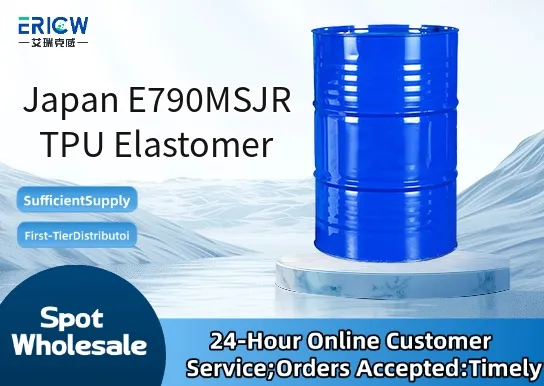
| Chemical Type | Aliphatic polyester-based thermoplastic polyurethane |
| Product Form | Pellets (free-flowing, uniform size) |
| Appearance | Translucent, slightly amber-tinted granules |
| Hardness (Shore A) | 78–82 |
| Melt Flow Rate (210 °C / 5 kg) | 12–16 g/10 min |
| Density | 1.18–1.20 g/cm³ |
| Key Features | Hydrolysis resistance, UV stability, low extractables |
| Primary Applications | Extruded films, medical tubing, precision overmolding |
Q1: What is the primary application focus of Japan E790MSJR TPU Elastomer?
A: Japan E790MSJR is specifically engineered for high-performance thermoplastic polyurethane applications requiring excellent melt processability, consistent clarity, and balanced mechanical resilience—commonly used in precision extrusion, thin-wall injection molding, and soft-touch overmolding of medical and consumer device components.
Q2: Is Japan E790MSJR suitable for medical-grade applications?
A: While Japan E790MSJR is manufactured under strict quality control and complies with general polymer purity expectations for healthcare-adjacent use, it is not pre-certified to ISO 10993 or USP Class VI. End users must conduct full biocompatibility and extractables testing as part of their regulatory submission process.
Q3: How does Japan E790MSJR differ from standard aromatic TPU grades in processing behavior?
A: Unlike conventional aromatic TPUs, Japan E790MSJR features a modified soft-segment architecture that enhances thermal stability during melt processing—reducing yellowing tendency and improving viscosity consistency across extended residence times in extruders and injection units.
Q4: Can Japan E790MSJR be blended with other polymers?
A: Yes—Japan E790MSJR demonstrates good compatibility with selected polyolefins and certain polyester elastomers when used with appropriate compatibilizers. However, blending with PVC or highly polar engineering resins is not recommended without prior rheological and phase-stability evaluation.
Q5: What drying conditions are recommended prior to processing?
A: To ensure optimal melt integrity and surface quality, drying at 80–90 °C for 3–4 hours under dehumidified air is strongly advised. Residual moisture above 0.02% may lead to splay, reduced tensile strength, or haze formation in transparent parts.
Contact With Us:
E-mail: wangxingqiang@ericwchem.com
Have a Questions? Call Us:
Add:
Building A1, Jiete Industrial Park, Huangpu District, Guangzhou City, Guangdong Province, China