English
 Español
 tiếng việt
 русский
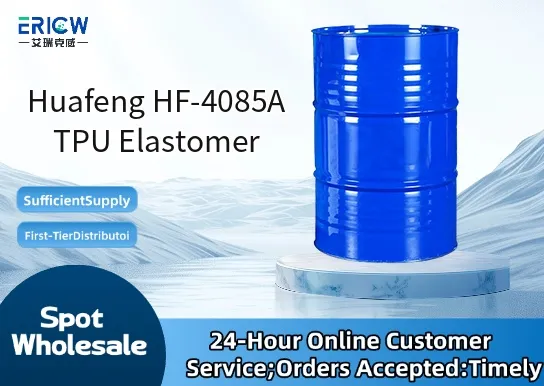
Excellent abrasion resistance for extended service life in demanding mechanical environments.
Outstanding low-temperature flexibility down to –30 °C without significant loss of elasticity.
Good oil and grease resistance suitable for industrial and automotive component applications.
High melt flow index enabling efficient processing via extrusion, injection molding, and calendering.
Excellent transparency and clarity retention after processing and aging.
Automotive interior trim components including instrument panel overlays and door armrests.
Medical tubing and flexible connectors requiring biocompatibility and kink resistance.
Industrial hoses and pneumatic tubing for compressed air and fluid transfer systems.
High-performance sporting goods such as ski boot cuffs and protective gear linings.
Consumer electronics protective cases and wearable device straps with premium tactile feel.
| Chemical Type | Aliphatic polyester-based thermoplastic polyurethane |
| Product Form | Pellets |
| Appearance | Translucent, off-white granules |
| Density (g/cm³) | 1.18–1.20 |
| Melt Flow Index (230 °C/2.16 kg, g/10 min) | 10–14 |
| Shore A Hardness | 85 ± 2 |
| Tensile Strength (MPa) | 32–36 |
| Elongation at Break (%) | 550–620 |
Q1: What are the primary processing methods suitable for HF-4085A?
A: HF-4085A is designed for melt-processing techniques including extrusion, injection molding, and blow molding. Its balanced melt viscosity and thermal stability support consistent flow and good surface finish across these methods.
Q2: Is HF-4085A compatible with common engineering thermoplastics for alloying or blending?
A: Yes, HF-4085A demonstrates good compatibility with polyesters (e.g., PET, PBT) and certain polyolefins when properly formulated. Compatibility should be verified experimentally for each intended blend system due to sensitivity to polarity and thermal history.
Q3: How does HF-4085A perform in applications requiring abrasion resistance and flexibility at low temperatures?
A: HF-4085A delivers excellent dynamic mechanical performance, maintaining elasticity and tear strength down to approximately −30 °C while offering high resistance to wear and repeated flexing—making it well-suited for demanding elastomeric components in automotive and industrial settings.
Q4: Does HF-4085A require drying before processing, and what are the recommended conditions?
A: Yes, like most TPU grades, HF-4085A is hygroscopic and must be dried prior to processing. A typical recommendation is drying at 80–90 °C for 3–4 hours using a desiccant dryer to achieve a moisture content below 0.05%.
Contact With Us:
E-mail: wangxingqiang@ericwchem.com
Have a Questions? Call Us:
Add:
Building A1, Jiete Industrial Park, Huangpu District, Guangzhou City, Guangdong Province, China