English
 Español
 tiếng việt
 русский
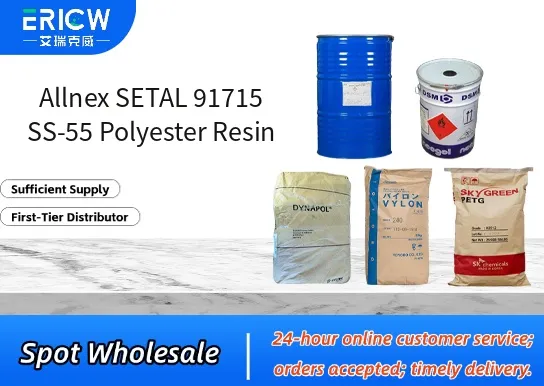
High-solids, low-VOC polyester resin designed for sustainable industrial coatings.
Excellent flow and leveling properties for smooth, defect-free film formation.
Good compatibility with melamine formaldehyde crosslinkers for enhanced cure performance.
Superior gloss retention and weather resistance in outdoor applications.
Consistent batch-to-batch reproducibility supporting reliable manufacturing processes.
Automotive OEM and refinish topcoats.
Industrial maintenance coatings for metal substrates.
Powder coating formulations requiring high-gloss, durable finishes.
General-purpose coil coating systems.
Appliance and architectural metal finishing.
| Chemical Type | Saturated polyester resin |
| Product Form | Liquid (solution in aromatic hydrocarbons) |
| Appearance | Clear, pale yellow liquid |
| Non-Volatile Content (NV %) | 55 ± 1 % (by weight, 120 °C, 60 min) |
| Acid Value | 12–16 mg KOH/g |
| Hydroxyl Value | 85–95 mg KOH/g |
| Viscosity (25 °C) | 4,000–6,000 mPa·s (Brookfield, spindle #3, 20 rpm) |
| Primary Applications | High-performance thermosetting coatings requiring excellent durability and appearance |
Q1: What is the primary application of SETAL 91715 SS-55 in coating systems?
A: SETAL 91715 SS-55 is a solvent-based saturated polyester resin designed primarily as a crosslinker for high-performance thermosetting coil and can coatings, where it contributes to excellent hardness, flexibility, and chemical resistance after curing with melamine-formaldehyde resins.
Q2: Is SETAL 91715 SS-55 compatible with common amino crosslinkers used in industrial baking finishes?
A: Yes, it is specifically formulated for compatibility with standard melamine-formaldehyde crosslinkers, including both highly methylolated and partially butylated types, enabling robust cure response under typical coil coating bake schedules.
Q3: How does SETAL 91715 SS-55 support film formation and substrate adhesion in metal coating applications?
A: Its molecular structure provides balanced polarity and reactivity, promoting strong interfacial interaction with metal substrates and facilitating uniform film formation with good edge coverage—key for corrosion protection in demanding end uses such as appliance and building panels.
Q4: What solvent system is recommended for formulating with SETAL 91715 SS-55?
A: It is supplied in a xylene-based solvent blend and is best formulated using aromatic or mixed aromatic–ketone solvents to maintain solution stability and optimize viscosity control during production and application.
Contact With Us:
E-mail: wangxingqiang@ericwchem.com
Have a Questions? Call Us:
Add:
Building A1, Jiete Industrial Park, Huangpu District, Guangzhou City, Guangdong Province, China