English
 Español
 tiếng việt
 русский
Excellent film-forming capability with high gloss and clarity after drying.
Low VOC content, compliant with stringent environmental regulations including EU REACH and US EPA guidelines.
Good mechanical resistance, including abrasion, flex, and impact performance on flexible substrates.
Outstanding adhesion to diverse substrates such as PET, PVC, ABS, and treated polyolefins.
Stable dispersion in water with broad formulation compatibility—easily blended with acrylic emulsions and crosslinkers.
Water-based topcoats for automotive interior trim and dashboards.
Flexible packaging coatings requiring FDA-compliant indirect food contact suitability.
Leather finishing systems for synthetic and semi-synthetic leather substrates.
Industrial protective coatings for plastic components in electronics and appliances.
High-performance overprint varnishes for gravure and flexographic printing.
| Chemical Type | Anionic aliphatic polyester-based polyurethane dispersion |
| Product Form | Opaque white liquid |
| Appearance | Homogeneous milky dispersion, no sedimentation |
| Solids Content (wt%) | 30.0 ± 1.0% |
| pH Value | 7.8 – 8.5 |
| Viscosity (mPa·s, Brookfield RVT, #2 spindle, 20 rpm) | 150 – 350 |
| Particle Size (D50, nm) | 80 – 120 |
| Minimum Film Formation Temperature (MFFT) | 15 °C |
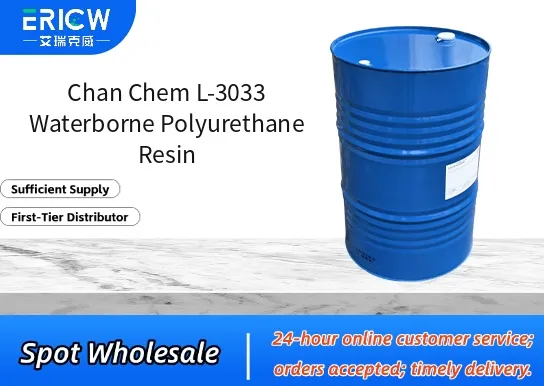
Q1: What are the primary application areas for Chan Chem L-3033?
A: Chan Chem L-3033 is widely used in waterborne coatings for flexible substrates—including synthetic leather, textiles, and automotive interior trim—where high elasticity, abrasion resistance, and low-VOC performance are required.
Q2: Is L-3033 compatible with common waterborne acrylic or polyester dispersions?
A: Yes, L-3033 demonstrates good compatibility with many standard waterborne acrylics, polyesters, and cellulose derivatives when properly mixed under mild shear and pH-controlled conditions (typically pH 7.5–9.0).
Q3: How should L-3033 be stored to maintain stability?
A: Store in tightly sealed containers at temperatures between 5 °C and 35 °C, away from freezing conditions and direct sunlight. Prolonged exposure to temperatures below 5 °C may cause irreversible coagulation.
Q4: Can L-3033 be crosslinked with external agents to enhance film properties?
A: Yes, L-3033 contains reactive functional groups that allow effective post-crosslinking with water-dispersible aziridines, carbodiimides, or blocked isocyanates—enabling improved chemical resistance, heat resistance, and mechanical strength upon curing.
Contact With Us:
E-mail: wangxingqiang@ericwchem.com
Have a Questions? Call Us:
Add:
Building A1, Jiete Industrial Park, Huangpu District, Guangzhou City, Guangdong Province, China