English
 Español
 tiếng việt
 русский
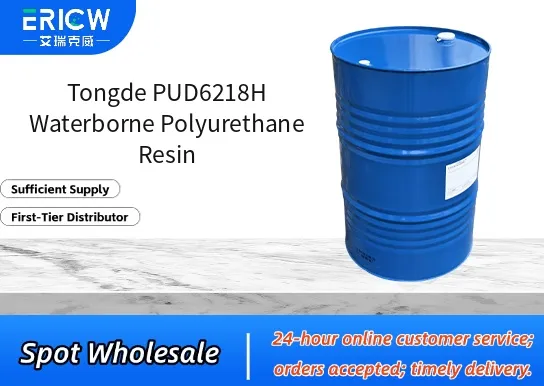
Excellent film-forming capability with high transparency and gloss retention.
Superior flexibility and abrasion resistance for demanding coating applications.
Low VOC content, compliant with stringent environmental and occupational safety regulations.
Good compatibility with acrylic emulsions and water-based additives.
Stable storage performance at room temperature (up to 12 months in sealed original packaging).
Water-based leather finishing topcoats and protective coatings.
High-performance wood coatings for furniture and interior decoration.
Flexible packaging laminating adhesives requiring FDA-compliant formulations.
Textile coatings for functional finishes including wind/water resistance.
Industrial maintenance coatings for metal and plastic substrates.
| Chemical Type | Aliphatic polyurethane dispersion |
| Product Form | White to slightly yellow aqueous dispersion |
| Appearance | Opaque liquid, homogeneous without sedimentation |
| Solids Content (wt%) | 30.0 ± 1.0% |
| pH Value | 7.5 – 8.5 |
| Viscosity (mPa·s, 25°C, Brookfield RVT, #3 spindle, 12 rpm) | 150 – 400 |
| Particle Size (D50, nm) | 80 – 120 |
| Minimum Film Formation Temperature (MFFT) | ≤ 10°C |
Q1: What are the primary application areas for Tongde PUD6218H?
A: Tongde PUD6218H is widely used in high-performance waterborne coatings for flexible substrates, including synthetic leather finishing, textile coatings, and soft-touch decorative films. Its excellent film-forming ability and low-temperature flexibility make it especially suitable for applications requiring good elongation and abrasion resistance.
Q2: How does PUD6218H perform in terms of chemical resistance and durability?
A: PUD6218H delivers enhanced resistance to common solvents, mild acids and alkalis, and maintains stable mechanical properties after aging or exposure to humidity. Its crosslinkable structure supports improved scrub resistance and long-term adhesion on diverse substrates when properly formulated and cured.
Q3: Is PUD6218H compatible with other waterborne resins or additives?
A: Yes, PUD6218H demonstrates good compatibility with many acrylic emulsions, waterborne polyesters, and common functional additives such as defoamers, wetting agents, and rheology modifiers. Compatibility testing under specific formulation conditions is recommended prior to full-scale production.
Q4: What is the typical solids content and viscosity range of PUD6218H?
A: PUD6218H is supplied as a stable aqueous dispersion with solids content typically around 30–35% and a Brookfield viscosity generally below 500 mPa·s at 25°C. These values may vary slightly depending on batch and storage conditions, so users should verify upon receipt.
Q5: Does PUD6218H require post-crosslinking for optimal performance?
A: While PUD6218H forms coherent, flexible films on its own, incorporating a suitable water-dispersible crosslinker—such as aziridine or carbodiimide types—can significantly enhance chemical resistance, hardness, and heat stability, particularly in demanding end-use environments.
Contact With Us:
E-mail: wangxingqiang@ericwchem.com
Have a Questions? Call Us:
Add:
Building A1, Jiete Industrial Park, Huangpu District, Guangzhou City, Guangdong Province, China