English
 Español
 tiếng việt
 русский
Low-VOC, environmentally compliant formulation meeting stringent global regulatory requirements.
Excellent film-forming capability with high gloss retention and superior clarity.
Outstanding flexibility and abrasion resistance after curing.
Good compatibility with acrylics, cellulose derivatives, and common waterborne additives.
Stable dispersion across pH 7.5–8.5 and compatible with standard industrial coating equipment.
Waterborne wood coatings for furniture and interior joinery.
Flexible packaging inks requiring low migration and FDA-compliant adhesion.
Leather finishing topcoats for footwear and upholstery.
Industrial maintenance coatings for metal substrates under mild exposure conditions.
Decorative architectural coatings where low odor and rapid dry-through are critical.
| Chemical Type | Anionic aliphatic polyester-based polyurethane dispersion |
| Product Form | Aqueous dispersion |
| Appearance | Transparent to slightly opalescent liquid |
| Solids Content (wt%) | 30.0 ± 1.0% |
| pH (25°C) | 7.8 – 8.2 |
| Viscosity (mPa·s, Brookfield RVT, #2 spindle, 20 rpm, 25°C) | 80 – 150 |
| Particle Size (D50, nm) | ≈ 45 – 65 |
| Minimum Film Formation Temperature (MFFT) | 12°C |
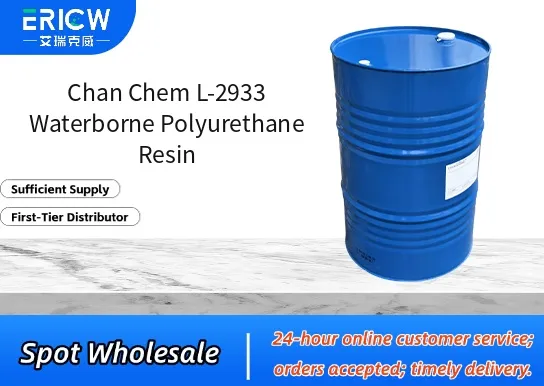
Q1: What are the primary application areas for Chan Chem L-2933?
A: Chan Chem L-2933 is widely used in water-based coatings and inks for flexible packaging, paper lamination, and textile finishing—where excellent film flexibility, adhesion to low-energy substrates, and low-VOC performance are required.
Q2: Is L-2933 compatible with other waterborne resins or additives?
A: Yes, L-2933 demonstrates good compatibility with common waterborne acrylics, styrene-acrylic emulsions, and crosslinkers such as aziridine or carbodiimide types—though compatibility should always be verified in the final formulation under intended processing conditions.
Q3: How does L-2933 perform in terms of heat resistance and blocking behavior?
A: Films formed from L-2933 exhibit good resistance to moderate heat exposure and low tendency toward blocking under light pressure and ambient storage conditions—performance can be further enhanced with appropriate crosslinking or formulation optimization.
Q4: Does L-2933 require neutralization before use?
A: No, L-2933 is supplied as a stable, self-emulsified dispersion at near-neutral pH and is typically ready for direct incorporation into formulations without pre-neutralization.
Contact With Us:
E-mail: wangxingqiang@ericwchem.com
Have a Questions? Call Us:
Add:
Building A1, Jiete Industrial Park, Huangpu District, Guangzhou City, Guangdong Province, China