English
 Español
 tiếng việt
 русский
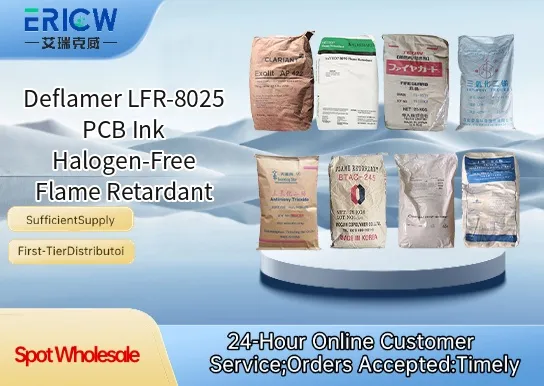
UL 94 V-0 rated flame retardancy without halogen-containing compounds.
Excellent thermal stability compatible with standard PCB ink curing processes (130–160 °C).
High compatibility with acrylic and epoxy-based solder mask and legend inks.
Low smoke density and negligible corrosive gas emission during combustion.
RoHS-compliant and meets IEC 61249-2-21 halogen-free requirements (Cl ≤ 900 ppm, Br ≤ 900 ppm).
Solder mask formulations for high-reliability automotive electronics PCBs.
Legend inks used in consumer electronics requiring stringent fire safety certification.
Flexible PCB coverlay inks for wearables and IoT devices.
High-frequency communication boards where low halogen content prevents signal degradation.
Industrial control system PCBs operating in confined or ventilated-limited environments.
| Chemical Type | Organophosphorus-based synergistic flame retardant |
| Product Form | Fine white to off-white powder |
| Appearance | Free-flowing, non-hygroscopic powder |
| Primary Applications | Halogen-free solder mask and legend inks for rigid/flexible PCBs |
| Key Features | Non-migrating, thermally stable, ink-dispersion friendly |
| Benefits | Maintains ink adhesion, flexibility, and dielectric performance |
| Storage Conditions | Store in cool, dry place (<25 °C); keep container tightly sealed |
| Regulatory Compliance | RoHS 2015/863/EU, REACH SVHC free, IEC 61249-2-21 compliant |
Q1: What makes Deflamer LFR-8025 suitable for halogen-free PCB ink formulations?
A: Deflamer LFR-8025 is a phosphorus-based flame retardant specifically engineered for compatibility with UV-curable and thermally cured PCB inks. It delivers effective flame retardancy without halogenated compounds, supporting compliance with RoHS, REACH, and industry expectations for low-smoke, low-toxicity emissions during soldering or end-use operation.
Q2: How does LFR-8025 affect ink viscosity, curing speed, and adhesion to copper substrates?
A: When properly dispersed, LFR-8025 exhibits minimal impact on rheology and cure kinetics in standard PCB ink systems. It maintains good interfacial compatibility with common acrylic and epoxy resins, supporting robust adhesion to copper and solder mask layers without requiring major reformulation. Pre-dispersion and controlled addition are recommended to ensure uniform distribution.
Q3: Can LFR-8025 be used in both solder mask and legend inks?
A: Yes — LFR-8025 has been successfully incorporated into both solder mask and legend ink formulations. Its thermal stability up to typical reflow profiles and low volatility support consistent performance across multiple ink types, provided compatibility testing is conducted under the intended curing and post-processing conditions.
Q4: Is special handling or stabilization required during ink manufacturing or storage?
A: LFR-8025 is stable under ambient storage conditions and does not require inert atmosphere handling. However, due to its fine particle nature, it should be added gradually with high-shear mixing to avoid agglomeration. Long-term storage of formulated inks may benefit from mild agitation to maintain dispersion homogeneity, particularly in low-viscosity systems.
Q5: Does LFR-8025 contribute to electrical insulation properties in finished PCB coatings?
A: Yes — as a non-ionic, low-migration phosphorus compound, LFR-8025 supports stable dielectric performance in cured films. It does not introduce ionic impurities that could compromise surface insulation resistance (SIR), making it suitable for high-reliability PCB applications where long-term electrical integrity is critical.
Contact With Us:
E-mail: wangxingqiang@ericwchem.com
Have a Questions? Call Us:
Add:
Building A1, Jiete Industrial Park, Huangpu District, Guangzhou City, Guangdong Province, China