English
 Español
 tiếng việt
 русский
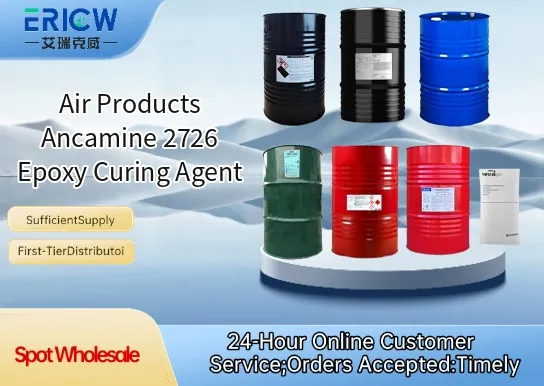
Fast-reacting aliphatic amine curing agent designed for ambient-cure epoxy systems.
Provides excellent mechanical properties, including high tensile strength and impact resistance.
Low viscosity enables easy handling, good wetting of fillers and reinforcements, and reduced mixing energy.
Low volatility and low odor support safer workplace handling versus conventional amine hardeners.
Enables formulation flexibility with broad compatibility across standard bisphenol-A and bisphenol-F epoxy resins.
Structural adhesives for aerospace and transportation bonding.
High-performance industrial flooring and protective coatings.
Electrical encapsulation and potting compounds requiring rapid ambient cure.
Composite repair systems and filament-wound components.
Tooling and mold-making materials demanding dimensional stability and low exotherm.
| Chemical Type | Aliphatic polyamine |
| Product Form | Liquid |
| Appearance | Clear, pale yellow liquid |
| Primary Applications | Ambient-cure structural adhesives, coatings, composites, and encapsulants |
| Key Features | Fast ambient cure, low viscosity, low volatility, broad resin compatibility |
| Benefits | Improved productivity, enhanced worker safety, consistent performance, simplified processing |
| Storage Stability | Stable under dry, cool conditions (15–25°C) in sealed containers |
| Reactivity Profile | Reacts readily at room temperature; gel time ~30–60 min (with DGEBA resin, 100 phr) |
Q1: What is the primary chemical class of Ancamine 2726?
A: Ancamine 2726 is an aliphatic amine-based epoxy curing agent, specifically formulated as a low-viscosity, reactive diluent-modified polyamine to enhance processability and reduce exotherm in demanding applications.
Q2: Is Ancamine 2726 suitable for ambient-cure epoxy systems?
A: Yes — Ancamine 2726 is designed for ambient- or moderate-temperature cure profiles, offering good reactivity at room temperature while maintaining extended pot life when properly formulated with standard DGEBA resins.
Q3: How does Ancamine 2726 compare to traditional polyamine hardeners in terms of flexibility and toughness?
A: Due to its tailored molecular architecture, Ancamine 2726 delivers improved flexibility and impact resistance in cured epoxy networks compared to conventional unmodified aliphatic amines — without sacrificing adhesion or chemical resistance in protective coating and composite applications.
Q4: Can Ancamine 2726 be used in high-solids or solvent-free epoxy formulations?
A: Yes — its low viscosity and high amine hydrogen equivalent weight make it well-suited for high-solids and 100%-solids epoxy systems, supporting reduced VOC content while maintaining workable rheology and film formation.
Q5: What types of epoxy resins is Ancamine 2726 typically paired with?
A: Ancamine 2726 is commonly used with standard liquid bisphenol-A (DGEBA) and bisphenol-F epoxy resins, as well as certain cycloaliphatic and novolac epoxies — particularly where balanced cure speed, low blush tendency, and good substrate wetting are required.
Contact With Us:
E-mail: wangxingqiang@ericwchem.com
Have a Questions? Call Us:
Add:
Building A1, Jiete Industrial Park, Huangpu District, Guangzhou City, Guangdong Province, China