English
 Español
 tiếng việt
 русский
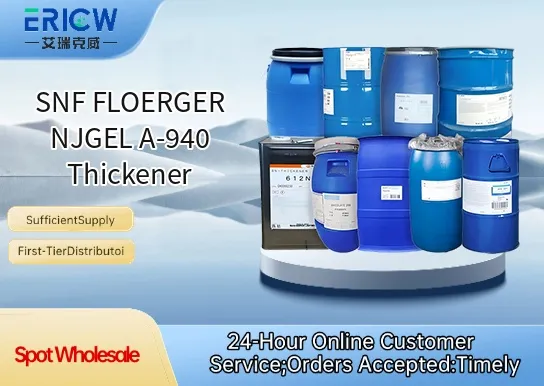
High-efficiency associative thickener delivering excellent rheology control in aqueous systems.
Compatible with anionic, nonionic, and zwitterionic surfactants commonly used in industrial formulations.
Provides outstanding shear-thinning behavior and long-term viscosity stability under varying pH conditions (pH 4–11).
Low foaming profile, supporting high-performance applications where foam interference must be minimized.
Readily dispersible in cold water, enabling simplified handling and efficient incorporation without pre-hydration.
Architectural coatings including interior and exterior latex paints.
Industrial maintenance coatings and protective primers.
Tile adhesives and cementitious grouts requiring non-drip consistency.
Textile printing pastes for precise pigment deposition and sharp pattern definition.
Agrochemical suspension concentrates (SC) and emulsifiable concentrates (EC) formulations.
| Chemical Type | Hydrophobically modified ethoxylated urethane (HEUR) |
| Product Form | Clear to slightly hazy viscous liquid |
| Appearance | Off-white to pale yellow liquid |
| pH (1% aqueous solution) | 6.5 – 8.5 |
| Active Content | 30.0 ± 1.5 wt% |
| Viscosity (Brookfield RVT, spindle #3, 20 rpm, 25°C) | 15,000 – 25,000 cP |
| Solubility | Water-miscible; forms stable dispersions in water |
| Storage Stability | 12 months at 5–30°C in original sealed container |
Q1: What type of thickener is NJGEL A-940 and what is its primary chemical nature?
A: NJGEL A-940 is a high-performance, anionic polyacrylate-based rheology modifier designed for water-based systems. It functions primarily through associative thickening mechanisms, providing strong viscosity build-up and excellent shear-thinning behavior without requiring neutralization.
Q2: In which types of formulations is NJGEL A-940 most commonly used?
A: It is widely employed in architectural coatings, industrial maintenance paints, tile adhesives, grouts, and cementitious repair mortars—particularly where enhanced sag resistance, improved open time, and stable viscosity under varying pH or electrolyte conditions are required.
Q3: How does NJGEL A-940 perform in the presence of high electrolyte concentrations?
A: NJGEL A-940 exhibits good tolerance to moderate levels of salts and common construction additives, maintaining viscosity stability better than many conventional non-associative thickeners—though extreme ionic strength may require formulation adjustment or co-thickener support.
Q4: What is the typical dosage range for effective thickening with NJGEL A-940?
A: Dosage depends on formulation requirements and target viscosity, but it is typically used at low concentrations—generally ranging from 0.1% to 2% by weight of the total formulation—with optimal performance often achieved in the lower half of this range when properly dispersed.
Q5: Is special dispersion or activation required before incorporating NJGEL A-940 into a formulation?
A: Yes—NJGEL A-940 should be pre-dispersed in water or a compatible liquid carrier under moderate shear prior to addition. Direct powder addition to high-shear zones or low-viscosity phases may lead to agglomeration; gradual incorporation with adequate mixing ensures uniform hydration and full rheological development.
Contact With Us:
E-mail: wangxingqiang@ericwchem.com
Have a Questions? Call Us:
Add:
Building A1, Jiete Industrial Park, Huangpu District, Guangzhou City, Guangdong Province, China