English
 Español
 tiếng việt
 русский
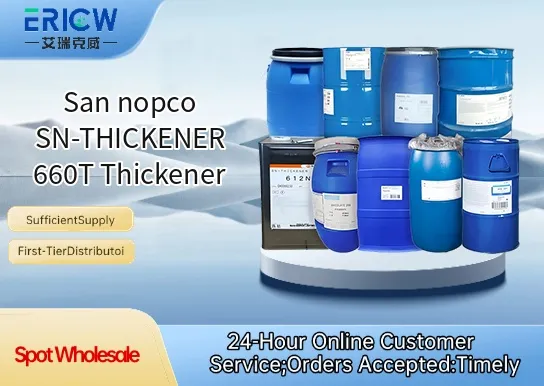
Non-ionic, high-efficiency associative thickener for water-based systems.
Delivers excellent rheology control and outstanding sag resistance in vertical applications.
Compatible with a broad range of anionic and non-ionic surfactants, co-solvents, and biocides.
Enables low-VOC and zero-APEO formulations without compromising viscosity stability.
Provides rapid viscosity build-up upon addition and maintains long-term storage stability.
Architectural interior and exterior latex paints.
Waterborne industrial maintenance coatings.
Emulsion-based adhesives and construction sealants.
Textile printing pastes and pigment dispersions.
Carpet backing and nonwoven binder formulations.
| Chemical Type | Non-ionic hydrophobically modified ethoxylated urethane (HEUR) |
| Product Form | Clear to slightly hazy, viscous liquid |
| Appearance | Colorless to pale yellow liquid |
| pH (1% aqueous solution) | 6.5 – 8.0 |
| Solids Content (wt%) | 30.0 ± 1.5% |
| Density (25°C, g/cm³) | 1.02 – 1.06 |
| Viscosity (Brookfield RVT, spindle #3, 20 rpm, 25°C, mPa·s) | 4,000 – 8,000 |
| Primary Applications | Waterborne coatings, adhesives, and functional dispersions |
Q1: What types of systems is SN-THICKENER 660T designed for?
A: SN-THICKENER 660T is a non-ionic associative thickener formulated primarily for water-based industrial coatings, architectural paints, and maintenance-grade protective coatings where balanced rheology, good sag resistance, and efficient shear-thinning behavior are required.
Q2: How should SN-THICKENER 660T be incorporated into a formulation?
A: It is typically added during the let-down stage, either neat or pre-diluted in water or compatible solvent. For optimal performance, allow sufficient mixing time to ensure full hydration and associative network development before adjusting pH or adding other additives.
Q3: Does SN-THICKENER 660T require pH adjustment to function effectively?
A: No — as a non-ionic thickener, SN-THICKENER 660T functions independently of pH and remains stable across a broad pH range (approximately 4–12), making it suitable for both acidic and alkaline formulations without sensitivity to pH drift.
Q4: How does SN-THICKENER 660T affect film formation and drying behavior?
A: It contributes minimal volatile content and does not significantly hinder coalescence or film formation. Formulations generally retain good leveling and dry-to-touch characteristics while achieving improved wet-film stability and reduced settling.
Q5: Is SN-THICKENER 660T compatible with common biocides and defoamers used in coatings?
A: Yes — it demonstrates broad compatibility with standard isothiazolinone and benzisothiazolinone biocides, as well as silicone and mineral oil-based defoamers. However, compatibility testing under actual formulation conditions is recommended prior to full-scale implementation.
Contact With Us:
E-mail: wangxingqiang@ericwchem.com
Have a Questions? Call Us:
Add:
Building A1, Jiete Industrial Park, Huangpu District, Guangzhou City, Guangdong Province, China