English
 Español
 tiếng việt
 русский
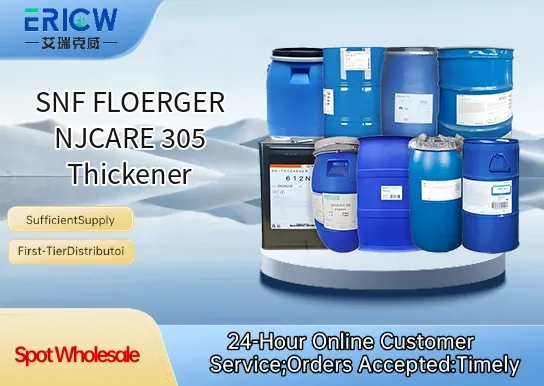
High-performance associative thickener delivering excellent rheology control in aqueous systems.
Provides outstanding sag resistance and brush drag reduction in architectural coatings.
Compatible with a broad range of anionic, nonionic, and zwitterionic surfactants.
Enables low-odor, low-VOC formulations without compromising viscosity stability.
Offers robust tolerance to electrolytes and pH variations (pH 4–12).
Interior and exterior latex paints for residential and commercial use.
Textured decorative coatings and plaster-based finishes.
Water-based wood stains and clear varnishes.
Tile grouts and cementitious repair mortars.
Industrial maintenance coatings requiring high shear-thinning performance.
| Chemical Type | Hydrophobically modified ethoxylated urethane (HEUR) |
| Product Form | Clear to slightly hazy viscous liquid |
| Appearance | Off-white to pale yellow liquid |
| pH (1% aqueous solution) | 6.5 – 8.5 |
| Solids Content (wt%) | 30.0 ± 1.0% |
| Density (25°C) | 1.02 – 1.06 g/cm³ |
| Viscosity (Brookfield DV-II, Spindle #3, 20 rpm, 25°C) | 15,000 – 25,000 cP |
| Primary Applications | Architectural coatings, cementitious systems, water-based industrial finishes |
Q1: What type of thickening mechanism does NJCARE 305 employ?
A: NJCARE 305 is a non-ionic polymeric thickener that functions primarily through chain entanglement and hydration in aqueous systems, delivering stable viscosity enhancement without significant sensitivity to pH or electrolytes.
Q2: Is NJCARE 305 compatible with common preservatives and surfactants used in personal care formulations?
A: Yes, NJCARE 305 demonstrates broad compatibility with anionic, non-ionic, and amphoteric surfactants, as well as widely used cosmetic preservatives—including parabens, phenoxyethanol, and isothiazolinones—under typical formulation conditions.
Q3: How should NJCARE 305 be incorporated into a formulation to ensure optimal dispersion and performance?
A: For best results, pre-disperse NJCARE 305 in water or glycerin under moderate shear before adding to the main batch; avoid direct addition to highly ionic or low-pH phases without prior hydration. Gentle heating (up to 40–50 °C) may accelerate dissolution but is not required.
Q4: Does NJCARE 305 offer any rheological benefits beyond viscosity increase?
A: Yes—it imparts mild pseudoplastic (shear-thinning) behavior, supporting improved application feel and suspension stability while maintaining good flow at rest, making it suitable for gels, lotions, and cleansing bases.
Q5: Can NJCARE 305 be used in rinse-off versus leave-on products?
A: NJCARE 305 is formulated for versatility across both rinse-off (e.g., shampoos, body washes) and leave-on applications (e.g., moisturizing gels, serums), with performance tailored by dosage and formulation matrix.
Contact With Us:
E-mail: wangxingqiang@ericwchem.com
Have a Questions? Call Us:
Add:
Building A1, Jiete Industrial Park, Huangpu District, Guangzhou City, Guangdong Province, China