English
 Español
 tiếng việt
 русский
Excellent clarity and UV stability for long-term optical performance.
High molecular weight ethyl acrylate/methyl methacrylate copolymer offering superior toughness and flexibility.
Low yellowing tendency and exceptional aging resistance in both film and solution forms.
Soluble in common organic solvents including toluene, xylene, acetone, and ethyl acetate.
Non-yellowing binder with excellent adhesion to diverse substrates including metals, plastics, and aged coatings.
Consolidant and protective coating for archaeological artifacts and historical stone/mortar.
Binder in conservation-grade varnishes and reversible surface treatments for paintings and polychrome objects.
Component in high-performance architectural clear coatings for concrete and masonry restoration.
Matrix resin in specialty adhesives for museum-quality mounting and reversible bonding.
Film-forming agent in pigment dispersions for fine art restoration and conservation-grade paints.
| Chemical Type | Ethyl acrylate/methyl methacrylate copolymer |
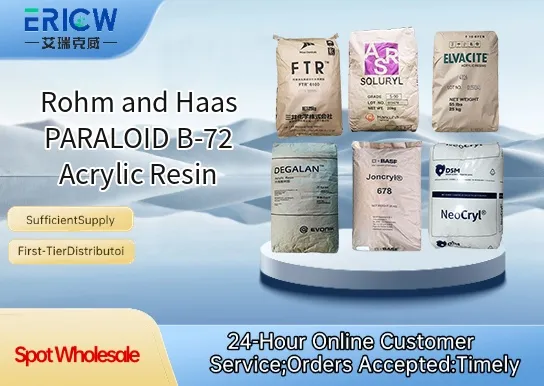
| Product Form | White granular solid |
| Appearance | Off-white to pale yellow granules |
| Primary Applications | Conservation, restoration, architectural coatings, reversible adhesives |
| Key Features | Reversibility, low viscosity in solution, excellent clarity, non-yellowing |
| Recommended Solvents | Toluene, xylene, acetone, ethyl acetate, MEK |
| Typical Solution Viscosity (20% in Toluene) | ~30–40 cP at 25°C |
| Specific Gravity (25°C) | 1.18–1.20 g/cm³ |
Q1: What are the primary applications of PARALOID B-72 in conservation and restoration?
A: PARALOID B-72 is widely used by conservators for consolidation of fragile archaeological materials, as a reversible adhesive for ceramics and stone, and as a protective coating for porous substrates such as bone, wood, and plaster. Its excellent aging characteristics, clarity, and solubility in low-toxicity solvents make it especially suitable for sensitive cultural heritage applications.
Q2: How does PARALOID B-72 compare to other acrylic resins in terms of yellowing resistance and long-term stability?
A: PARALOID B-72 exhibits superior resistance to yellowing and embrittlement under ambient and accelerated aging conditions compared to many older-generation acrylics and natural resins. Its aliphatic backbone contributes to enhanced UV stability, and it has demonstrated excellent performance in museum environments over decades of real-world use.
Q3: Which solvents are commonly used to dissolve PARALOID B-72 for practical application?
A: PARALOID B-72 dissolves readily in aromatic hydrocarbons (e.g., toluene, xylene), ketones (e.g., acetone, MEK), and esters (e.g., ethyl acetate). It is insoluble in alcohols and water. Solvent selection depends on evaporation rate, safety requirements, and substrate compatibility—conservators often prefer slower-evaporating blends to control penetration and working time.
Q4: Is PARALOID B-72 compatible with other polymers or additives in multi-component formulations?
A: Yes, PARALOID B-72 shows good compatibility with many cellulose derivatives (e.g., ethyl cellulose), certain plasticizers, and pigment dispersions. However, compatibility should always be verified empirically in the final formulation, as interactions can affect film formation, clarity, and mechanical properties.
Contact With Us:
E-mail: wangxingqiang@ericwchem.com
Have a Questions? Call Us:
Add:
Building A1, Jiete Industrial Park, Huangpu District, Guangzhou City, Guangdong Province, China