English
 Español
 tiếng việt
 русский
Excellent abrasion resistance for extended service life in demanding mechanical environments.
High tensile strength and elongation at break, enabling robust performance under dynamic stress.
Good low-temperature flexibility down to –40 °C, maintaining elasticity in cold-condition applications.
Outstanding oil and grease resistance, ensuring dimensional stability in contact with hydrocarbon-based fluids.
Processable via standard thermoplastic techniques including extrusion, injection molding, and calendering.
Industrial hoses and tubing for hydraulic, pneumatic, and material handling systems.
Conveyor belting components requiring high wear resistance and load-bearing capability.
Automotive interior trim parts, including gear boots, dust caps, and grommets.
Footwear midsoles and outsoles where resilience, comfort, and durability are critical.
Medical device tubing and seals compliant with ISO 10993 biocompatibility guidelines (when compounded appropriately).
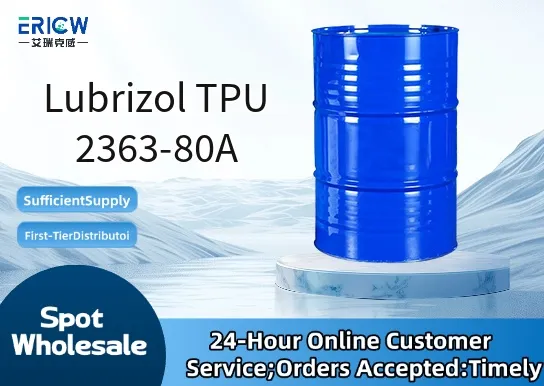
| Chemical Type | Thermoplastic Polyurethane (TPU), Polyester-based |
| Product Form | Pellets |
| Appearance | Off-white to light tan, free-flowing granules |
| Shore A Hardness | 80 ± 2 |
| Density | 1.18–1.20 g/cm³ |
| Melt Flow Index (210 °C/10 kg) | 10–14 g/10 min |
| Tensile Strength (ASTM D412) | 35–42 MPa |
| Elongation at Break (ASTM D412) | 500–600 % |
Q1: What is Lubrizol TPU 2363-80A primarily used for?
A: Lubrizol TPU 2363-80A is a thermoplastic polyurethane-based additive designed to enhance melt processability, surface finish, and low-temperature flexibility in engineering thermoplastics—particularly in TPU, TPE, and PVC compounds used for extruded profiles, injection-molded parts, and flexible tubing.
Q2: Is TPU 2363-80A compatible with common polymer matrices?
A: Yes—it exhibits broad compatibility with thermoplastic polyurethanes (TPUs), thermoplastic elastomers (TPEs), polyvinyl chloride (PVC), and certain polyolefin blends. Compatibility should be confirmed via small-scale trials due to formulation-specific interactions such as polarity and molecular weight distribution.
Q3: How is TPU 2363-80A typically incorporated into formulations?
A: It is generally introduced during compounding—via twin-screw extrusion or high-intensity mixing—and disperses readily without requiring pre-drying. Dosage depends on formulation requirements but typically ranges from 0.1% to 2% by weight relative to the base polymer.
Q4: Does TPU 2363-80A affect regulatory compliance of final articles?
A: Lubrizol TPU 2363-80A is not intended for direct food-contact or medical-device applications unless validated under applicable regulatory frameworks. Formulators are responsible for ensuring final compound compliance—including migration behavior and extractables—based on end-use conditions and regional requirements.
Contact With Us:
E-mail: wangxingqiang@ericwchem.com
Have a Questions? Call Us:
Add:
Building A1, Jiete Industrial Park, Huangpu District, Guangzhou City, Guangdong Province, China