English
 Español
 tiếng việt
 русский
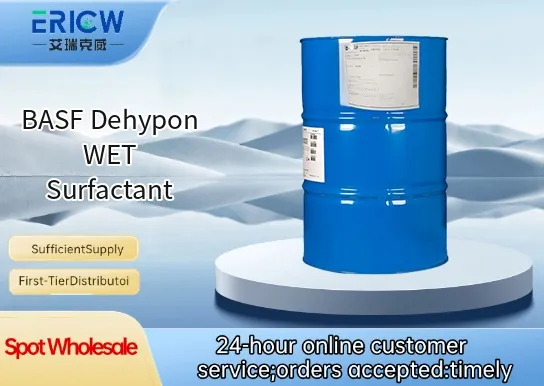
Highly effective wetting agent for rapid substrate penetration on low-energy surfaces.
Excellent compatibility with anionic, nonionic, and cationic systems in formulated products.
Low foaming profile suitable for high-shear industrial cleaning and coating processes.
Biodegradable surfactant based on renewable raw materials, meeting OECD 301 standards.
Stable across broad pH range (pH 2–12), ensuring robust performance in acidic and alkaline formulations.
Industrial and institutional (I&I) hard surface cleaners.
Agrochemical adjuvants for improved spray coverage and foliar uptake.
Textile pre-treatment and dyeing auxiliaries.
Coating and ink additives for enhanced substrate wetting and leveling.
Concrete admixtures to improve workability and air entrainment control.
| Chemical Type | Alkyl polyglucoside (APG)-based nonionic surfactant |
| Product Form | Pale yellow to amber viscous liquid |
| Appearance | Clear to slightly hazy, homogeneous liquid |
| pH (1% aqueous solution) | 6.5 – 8.5 |
| Active Content | ≈ 45 – 50 wt.% (as supplied) |
| Density (20 °C) | 1.08 – 1.12 g/cm³ |
| Solubility | Freely soluble in water and polar organic solvents |
| Primary Applications | Wetting, dispersing, and emulsifying in industrial formulations |
Q1: What is the primary function of Dehypon WET Surfactant in industrial formulations?
A: Dehypon WET Surfactant is a nonionic surfactant designed primarily to provide efficient wetting and surface tension reduction in aqueous systems, supporting rapid substrate penetration and uniform coverage—especially on low-energy or hydrophobic surfaces.
Q2: Is Dehypon WET compatible with anionic and cationic surfactants?
A: Dehypon WET exhibits good compatibility with many anionic surfactants under typical formulation conditions and can be used in mixed-surfactant systems to enhance overall performance. Compatibility with cationic species should be evaluated case by case, as interactions may occur depending on pH, concentration, and ionic strength.
Q3: How does temperature affect the performance of Dehypon WET Surfactant?
A: As a nonionic ethoxylated surfactant, Dehypon WET shows reduced solubility and potential cloud point behavior at elevated temperatures. Optimal wetting performance is generally observed below its cloud point, which varies depending on concentration and electrolyte content in the system.
Q4: Can Dehypon WET be used in low-foaming applications?
A: Yes—Dehypon WET is formulated to deliver effective wetting with inherently low to moderate foaming characteristics, making it suitable for applications where foam control is important, such as cleaning-in-place (CIP) systems or high-shear industrial processes.
Q5: What are typical dosage ranges for Dehypon WET Surfactant in industrial cleaning or coating formulations?
A: Dosage depends on the specific application, substrate, and desired performance level, but Dehypon WET is typically used at low concentrations—generally ranging from 0.1% to 2% by weight in finished formulations.
Contact With Us:
E-mail: wangxingqiang@ericwchem.com
Have a Questions? Call Us:
Add:
Building A1, Jiete Industrial Park, Huangpu District, Guangzhou City, Guangdong Province, China