English
 Español
 tiếng việt
 русский
Tronox Titanium Dioxide chloride-processed TiO₂ series combines zirconia/alumina surface treatments with <0.3 μm particle optimization to deliver 97-99% rutile purity across coatings, polymers, and inks. The advanced surface modification ensures 1.55-1.65 refractive index alignment, achieving MY 9.8-10.2 brightness (ASTM D2745) and ≥98% opacity in thin-film systems
Ideal for solvent/waterborne coatings, the grades provide ≤20 g/L VOC compliance while maintaining 85-92% gloss retention (60° ASTM D523) under QUV-B accelerated weathering
In plastics, optimized dispersion reduces melt-flow resistance by 15-22%, supporting >25% pigment loading in PVC/PE masterbatches without compromising impact strength
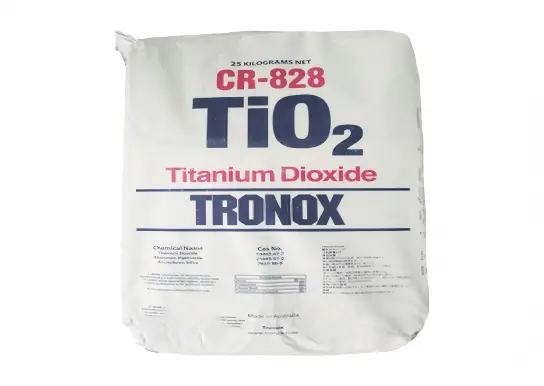
Rutile-type titanium dioxide with superior opacity and brightness
Chloride process manufacturing for consistent quality
Alumina and zirconia surface treatment for enhanced performance
Excellent tinting strength and gloss development
Suitable for both solvent- and water-based systems
Architectural and industrial coatings (interior/exterior)
PVC and polyolefin masterbatches
Flexographic and gravure printing inks
Maintenance and protective coatings
| Model | TiO₂ Content (min. %) | Crystal Form | Appearance | Specific Gravity (g/cm³) | pH | Oil Absorption (g/100g) |
| CR-880 | 93 | Rutile | White Powder | 4.1 | 7.4-7.6 | 17-18 |
| 8400 | 93 | Rutile | White Powder | 4.1 | 7.4-7.6 | 17-18 |
| 8300 | 93 | Rutile | White Powder | 4.1 | 7.4-7.6 | 17-18 |
| CR-813 | 93 | Rutile | White Powder | 4.1 | 7.4-7.6 | 17-18 |
| CR-834 | 93 | Rutile | White Powder | 4.1 | 7.4-7.6 | 17-18 |
| CR-826 | 97 | Rutile | White Powder | 4.1 | 7.5 | 19 |
| RCL69 | 97 | Rutile | White Powder | 4.1 | 7.5 | 19 |
| CR-828 | 93 | Rutile | White Powder | 4.1 | 7.4-7.6 | 17-18 |
Q1: What are the primary grades of Tronox titanium dioxide and how do they differ?
A: Tronox offers a range of titanium dioxide pigments—including rutile and anatase types—engineered for specific performance requirements. Rutile grades dominate in high-opacity, high-durability applications like architectural coatings and plastics, while select anatase grades are optimized for applications requiring high photocatalytic activity or lower UV absorption, such as certain specialty inks and cosmetics.
Q2: Is Tronox titanium dioxide suitable for use in food-contact or pharmaceutical applications?
A: Certain Tronox titanium dioxide products are manufactured and certified to meet regulatory requirements for indirect food contact applications, such as in packaging inks and polymer layers. However, suitability depends on the specific grade, intended use, and applicable regional regulations. Customers must consult Tronox’s regulatory documentation and conduct their own compliance assessment prior to use.
Q3: How does surface treatment affect the performance of Tronox titanium dioxide in different media?
A: Surface treatments—such as alumina, silica, zirconia, or organic modifications—are tailored to enhance dispersion stability, reduce photochemical reactivity, improve compatibility with resin systems, and optimize optical performance. For example, silica–alumina treated grades offer superior durability in exterior coatings, while organically modified versions improve wetting and rheology in solvent-based inks and high-solids formulations.
Q4: What guidance is available for dispersing Tronox titanium dioxide efficiently in industrial processes?
A: Optimal dispersion typically requires high-shear mixing, appropriate milling equipment, and formulation-specific wetting agents. Tronox recommends conducting lab-scale trials to determine ideal energy input, residence time, and additive selection—especially when transitioning between grades or media (e.g., water-based vs. solvent-based systems). Consistent dispersion is critical to achieving full hiding power and minimizing agglomeration-related defects.
Contact With Us:
E-mail: wangxingqiang@ericwchem.com
Have a Questions? Call Us:
Add:
Building A1, Jiete Industrial Park, Huangpu District, Guangzhou City, Guangdong Province, China