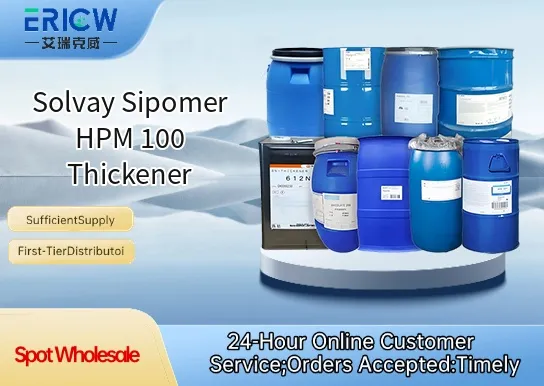
Features Of Dow ACRYSOL RM-12W Thickener
Efficient mid-shear thickening - Accurately increases mid-shear viscosity, suitable for multi-gloss coating formulations
Solvent-free & low VOC - No solvent added, low odor, meeting environmental low VOC standards
Anti-sag & anti-splashing - Balances flow and anti-sag, reduces roll coating splashing, improves workability
Wide system compatibility - Compatible with water-based emulsions and multiple additives, suitable for various coating formulations
Enzyme & microbial resistance - Resists enzyme and microbial attack, ensures long-term stability of viscosit
Typical Applications Of Dow ACRYSOL RM-12W Thickener
Water-based interior and exterior architectural latex paints - Optimizes rheology, improves anti-sag and leveling, enhances gloss and workability
High-gloss paints - Improves gloss development and film uniformity, suitable for low-VOC high-gloss formulations
Elastic coatings - Enhances anti-sag performance of elastic coatings, improves storage stability
Industrial anti-corrosion coatings - Suitable for water-based industrial coatings, improves workability and protection performance
Exterior insulation finish systems - Optimizes rheology of heavy-duty systems, enhances anti-sag and texture retention
Specifications Of Dow ACRYSOL RM-12W Thickener
| Appearance (25℃) | Turbid liquid |
| Active Ingredient | Approx. 25% |
| Density (25℃) | Approx. 1.02 g/cm³ |
| Viscosity (25℃) | Approx. 100-500 mPa·s |
| pH Value (25℃) | Approx. 6.0-8.0 |
| Applicable Systems | Water-based systems |
| Recommended Dosage | 0.1%-1.0% of total formula |
Dow ACRYSOL RM-12W Thickener – Frequently Asked Questions (FAQ)
Q1: What is the primary function of ACRYSOL RM-12W in waterborne formulations?
A: ACRYSOL RM-12W is a hydrophobically modified ethoxylated urethane (HEUR) rheology modifier designed to provide mid-shear viscosity control, sag resistance, and excellent flow/leveling balance in water-based paints, coatings, and architectural finishes.
Q2: How does RM-12W differ from associative thickeners based on acrylic or cellulose chemistries?
A: Unlike traditional polyacrylate or cellulose thickeners, RM-12W functions through associative thickening—forming reversible physical networks via hydrophobic interactions. This delivers superior shear-thinning behavior, improved spatter resistance, and better compatibility with surfactants and co-solvents commonly found in modern low-VOC formulations.
Q3: Is RM-12W suitable for use in high-solids or low-VOC systems?
A: Yes—RM-12W is specifically engineered for performance in low-VOC and high-solids waterborne systems. Its non-ionic nature and low aqueous sensitivity support formulation stability and consistent viscosity development without compromising environmental compliance targets.
Q4: What is the recommended addition method for optimal performance?
A: RM-12W should be added during the let-down stage, typically after pigments and base binders are dispersed. Pre-dilution with water or compatible co-solvent (e.g., propylene glycol) is recommended to ensure uniform incorporation and avoid localized overdosing or viscosity spikes.
Q5: Does RM-12W require pH adjustment or specific storage conditions?
A: RM-12W is pH-stable across typical architectural coating ranges (pH 7–10) and does not require pH adjustment for activation. Store in original sealed containers at temperatures between 5 °C and 30 °C, avoiding freezing and prolonged exposure to direct sunlight.
 English
 Español
 tiếng việt
 русский