English
 Español
 tiếng việt
 русский
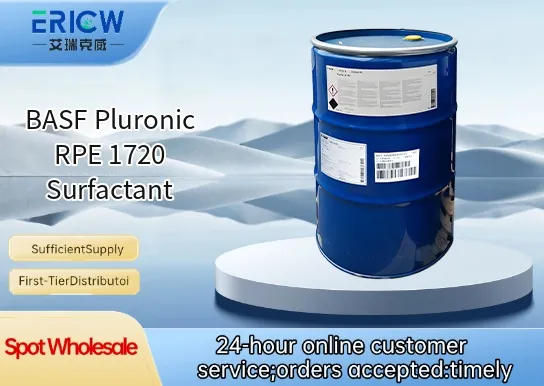
Nonionic triblock copolymer based on poly(ethylene oxide)-poly(propylene oxide)-poly(ethylene oxide) (PEO-PPO-PEO) architecture.
Optimized hydrophilic-lipophilic balance (HLB ≈ 20) for effective solubilization and stabilization in aqueous systems.
Low foaming profile suitable for high-shear and recirculating industrial processes.
Excellent thermal and pH stability across broad operating ranges (pH 3–11, up to 80 °C).
Readily biodegradable and compliant with OECD 301B screening criteria for environmental safety.
Stabilizer and solubilizer in agrochemical formulations (e.g., SC, SE, and OD concentrates).
Emulsifier in polymer emulsion synthesis, including styrene-butadiene and acrylic latexes.
Wetting and dispersing agent in industrial cleaning and metalworking fluid concentrates.
Viscosity modifier and co-stabilizer in personal care emulsions (e.g., sunscreens and cleansing lotions).
Performance additive in oilfield chemical systems for enhanced oil recovery (EOR) surfactant flooding.
| Chemical Type | Nonionic PEO-PPO-PEO triblock copolymer |
| Product Form | Pale yellow to colorless viscous liquid |
| Appearance | Clear, homogeneous liquid at 25 °C |
| Primary Applications | Agrochemicals, coatings, industrial cleaners, personal care, oilfield chemicals |
| Key Features | Low foaming, high solubilization capacity, excellent electrolyte tolerance |
| Benefits | Improved formulation stability, reduced active ingredient crystallization, enhanced wetting efficiency |
| pH (1% aqueous solution) | 6.0–7.5 |
| Cloud Point (1% aqueous solution) | ≈ 92 °C |
Q1: What is the primary functional role of Pluronic RPE 1720 in industrial formulations?
A: Pluronic RPE 1720 is a nonionic, polyether-based surfactant designed primarily for emulsification, solubilization, and stabilization in aqueous systems. Its balanced hydrophilic-lipophilic character supports performance in demanding applications such as agrochemical concentrates, industrial cleaners, and polymer dispersions.
Q2: How does Pluronic RPE 1720 differ from standard Pluronic F- or L-series grades?
A: Unlike conventional Pluronic grades based on PEO-PPO-PEO triblock architecture, RPE 1720 features a unique reverse polyether structure (PPO-PEO-PPO), resulting in enhanced oil-phase affinity, improved low-temperature stability, and distinct micellization behavior—particularly beneficial in high-solids or low-water-content formulations.
Q3: Is Pluronic RPE 1720 suitable for use in temperature-sensitive processes?
A: Yes—RPE 1720 exhibits good thermal stability and maintains surfactant functionality across a broad processing temperature range. It is commonly employed in hot-melt formulations, high-shear mixing, and ambient-cure coating systems without significant degradation or phase separation.
Q4: What are typical dosage guidelines when incorporating RPE 1720 into a formulation?
A: Dosage depends on formulation requirements and target performance, but RPE 1720 is typically used at low concentrations—generally ranging from 0.1% to 2% by weight—to achieve effective emulsification or solubilization without over-stabilization or foaming issues.
Q5: Can Pluronic RPE 1720 be blended with ionic surfactants or other nonionics?
A: Yes—it demonstrates good compatibility with many anionic, cationic, and other nonionic surfactants, enabling synergistic performance in complex surfactant blends. However, compatibility should be verified empirically in the final system due to potential interactions affecting cloud point, viscosity, or phase behavior.
Contact With Us:
E-mail: wangxingqiang@ericwchem.com
Have a Questions? Call Us:
Add:
Building A1, Jiete Industrial Park, Huangpu District, Guangzhou City, Guangdong Province, China