English
 Español
 tiếng việt
 русский
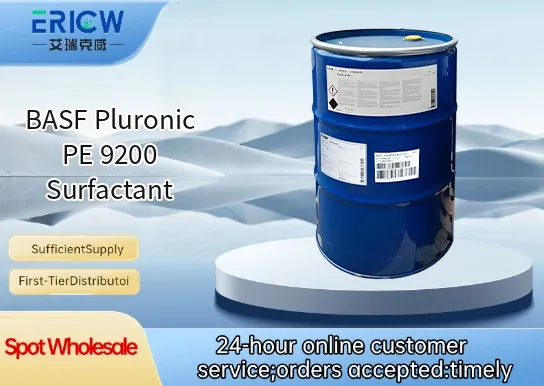
High molecular weight, triblock copolymer structure (PEO–PPO–PEO) delivering exceptional thermal and colloidal stability.
Nonionic surfactant with low foaming characteristics, ideal for high-shear and high-temperature processing environments.
Excellent solubilizing capacity for hydrophobic actives and oils across a broad pH range (pH 3–11).
Biocompatible and non-irritating profile, compliant with ICH Q5C guidelines for biopharmaceutical formulation excipients.
Readily water-soluble with controlled micellization behavior, enabling precise tuning of emulsion droplet size and stability.
Stabilizer in parenteral nanosuspensions and injectable micellar drug delivery systems.
Emulsifier and viscosity modifier in high-performance industrial cleaning formulations.
Dispersing aid in aqueous pigment dispersions for waterborne coatings and inks.
Processing aid in polymer latex synthesis to control particle nucleation and growth kinetics.
Functional additive in agricultural adjuvant systems for enhanced foliar uptake and rainfastness.
| Chemical Type | Triblock copolymer (Poly(ethylene oxide)-block-poly(propylene oxide)-block-poly(ethylene oxide)) |
| Product Form | White to off-white granules or flakes |
| Appearance | Free-flowing, hygroscopic solid |
| Cloud Point (1% aqueous solution) | ~75–78 °C |
| pH (1% aqueous solution, 25 °C) | 5.5–7.5 |
| Solubility in Water | Freely soluble at room temperature; forms clear, low-viscosity solutions |
| Primary Applications | Pharmaceutical formulations, industrial cleaners, coatings, agrochemicals, polymer synthesis |
| Key Features | Nonionic, low foaming, thermoresponsive, GMP-compatible manufacturing |
Q1: What is the primary chemical structure and classification of Pluronic PE 9200?
A: Pluronic PE 9200 is a nonionic triblock copolymer composed of a central hydrophobic polypropylene oxide (PPO) segment flanked by two hydrophilic polyethylene oxide (PEO) blocks. It belongs to the Pluronic® family of poloxamers and exhibits amphiphilic character, enabling surface activity, micelle formation, and solubilization behavior in aqueous systems.
Q2: In which types of industrial formulations is Pluronic PE 9200 commonly used?
A: This surfactant is frequently employed in demanding applications such as high-performance coatings, agrochemical suspensions, pharmaceutical dispersants, and advanced cleaning formulations—particularly where thermal stability, low foaming, and effective stabilization of hydrophobic actives are required.
Q3: How does Pluronic PE 9200 perform in high-temperature or high-salinity environments?
A: Due to its relatively high PPO content and molecular weight, PE 9200 demonstrates enhanced thermal stability and tolerance to electrolytes compared to lower-MW Pluronics. It maintains colloidal stability and surfactant functionality at elevated temperatures and in moderately saline media, though performance should be verified under specific formulation conditions.
Q4: Is Pluronic PE 9200 compatible with ionic surfactants and common polymer thickeners?
A: Yes, PE 9200 generally shows good compatibility with anionic and cationic surfactants, as well as associative and non-associative thickeners such as cellulose derivatives and acrylic polymers—making it suitable for complex, multi-component formulations. Compatibility testing is recommended to confirm physical stability and rheological behavior.
Q5: What is the typical dosage range for effective performance in aqueous systems?
A: Effective use levels typically range from 0.1% to 2% by weight, depending on the application objective—such as emulsification, dispersion stabilization, or wetting enhancement. Optimal dosage is formulation-specific and should be determined empirically through lab-scale evaluation.
Contact With Us:
E-mail: wangxingqiang@ericwchem.com
Have a Questions? Call Us:
Add:
Building A1, Jiete Industrial Park, Huangpu District, Guangzhou City, Guangdong Province, China