English
 Español
 tiếng việt
 русский
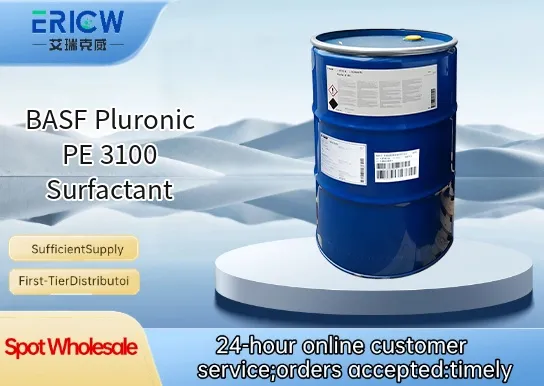
Non-ionic triblock copolymer based on poly(ethylene oxide)-poly(propylene oxide)-poly(ethylene oxide) (PEO-PPO-PEO) architecture.
Excellent wetting, dispersing, and solubilizing performance in aqueous and semi-aqueous systems.
Low foaming profile suitable for high-shear and industrial cleaning applications.
Good thermal and hydrolytic stability across a broad pH range (pH 4–11).
EcoVadis-recognized sustainable formulation component with readily biodegradable PEO segments.
Industrial and institutional (I&I) hard-surface cleaners.
Agrochemical adjuvants for improved active ingredient dispersion and foliar uptake.
Pharmaceutical solubilizers and excipients in liquid dosage forms.
Personal care formulations requiring mild, non-irritating emulsification (e.g., micellar cleansers).
Specialty coatings and inkjet ink stabilizers for pigment dispersion control.
| Chemical Type | Non-ionic PEO-PPO-PEO triblock copolymer |
| Product Form | Pale yellow to amber viscous liquid |
| Appearance | Clear to slightly hazy, homogeneous liquid at 25°C |
| Primary Applications | Wetting agent, dispersant, solubilizer, emulsifier |
| Key Features | Low foam, high HLB (~17.5), thermoresponsive behavior |
| Benefits | Enhanced formulation stability, reduced surfactant synergy requirements, compatibility with electrolytes |
| Storage Conditions | Store in original container at 10–30°C; protect from freezing and direct sunlight |
| Regulatory Status | REACH registered; compliant with US FDA 21 CFR §173.370 for indirect food additives |
Q1: What is the primary chemical nature and structure of Pluronic PE 3100?
A: Pluronic PE 3100 is a nonionic triblock copolymer composed of poly(propylene oxide) (PPO) flanked by poly(ethylene oxide) (PEO) blocks. It belongs to the Pluronic® PE series, which features a higher PPO content relative to standard Pluronic® L or F grades, resulting in enhanced hydrophobic character and temperature-responsive behavior such as reversible micellization.
Q2: In which types of industrial formulations is Pluronic PE 3100 most commonly applied?
A: It is widely used as a stabilizer, solubilizer, and emulsifier in demanding applications including agrochemical concentrates (e.g., SC and SE formulations), high-solids pigment dispersions, oilfield demulsifiers, and specialty cleaning systems where thermal stability and interfacial activity at elevated temperatures are required.
Q3: How does Pluronic PE 3100 behave in aqueous solution across temperature changes?
A: It exhibits characteristic thermoresponsive behavior: it remains fully soluble at lower temperatures but undergoes progressive micellization and may show cloud point behavior upon heating. This property enables its use in temperature-triggered release systems and viscosity modulation without requiring chemical modification.
Q4: Is Pluronic PE 3100 compatible with ionic surfactants and common formulation additives?
A: Yes — it demonstrates good compatibility with anionic, cationic, and zwitterionic surfactants, as well as with polymers, electrolytes, and organic solvents typically found in industrial concentrate formulations. Synergistic effects on emulsion stability and wetting performance are often observed when blended appropriately.
Q5: What are typical handling and storage recommendations for this product?
A: Store in original sealed containers at ambient temperatures, protected from moisture and direct sunlight. The material is supplied as a low-viscosity liquid or semi-solid paste depending on ambient conditions; gentle warming may be used to facilitate pumping or mixing if viscosity increases due to cooling, but prolonged exposure to temperatures above 60 °C should be avoided to maintain long-term stability.
Contact With Us:
E-mail: wangxingqiang@ericwchem.com
Have a Questions? Call Us:
Add:
Building A1, Jiete Industrial Park, Huangpu District, Guangzhou City, Guangdong Province, China