English
 Español
 tiếng việt
 русский
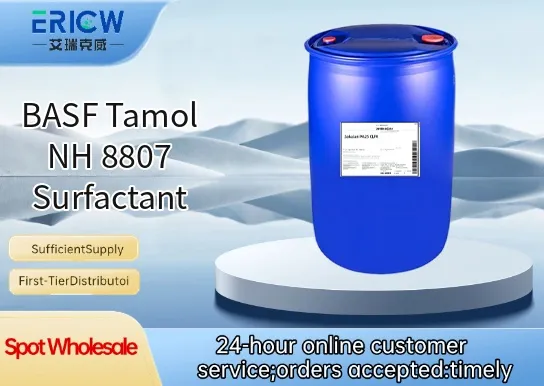
High-performance anionic dispersant based on sodium naphthalene formaldehyde condensate (NFC).
Excellent colloidal stability in high-solids, aqueous pigment dispersions and cementitious systems.
Low foaming profile, enabling reliable performance in high-shear mixing and pumping applications.
Good compatibility with a broad range of inorganic pigments, fillers, and hydraulic binders.
Non-volatile, APEO-free formulation supporting sustainable formulation goals.
Cement-based tile adhesives and grouts.
Waterborne architectural coatings and industrial paints.
Pigment concentrates (colorants) for construction chemicals.
Mineral-based dispersions for self-leveling underlayments and repair mortars.
Functional additives in gypsum-based plasters and dry-mix renders.
| Chemical Type | Sodium naphthalene formaldehyde condensate (NFC) |
| Product Form | Aqueous solution (~40% active content) |
| Appearance | Brownish viscous liquid |
| pH (1% aqueous solution) | 7.5 – 9.0 |
| Density (20 °C) | 1.18 – 1.22 g/cm³ |
| Solubility | Completely miscible with water |
| Primary Applications | Dispersant for pigments, fillers, and cement particles |
| Key Features | High dispersion efficiency, low foam, APEO-free |
Q1: What is the primary function of TAMOL NH 8807 in industrial formulations?
A: TAMOL NH 8807 is a sodium naphthalene formaldehyde condensate surfactant designed primarily as a dispersing agent and wetting aid. It helps stabilize pigment and filler particles in aqueous systems by providing electrostatic repulsion and steric hindrance, thereby improving grind efficiency, suspension stability, and rheological behavior.
Q2: In which types of applications is TAMOL NH 8807 most commonly used?
A: It is widely employed in water-based coatings (e.g., architectural and industrial paints), construction chemicals (such as cementitious tile adhesives and grouts), agrochemical suspensions (SC and SE formulations), and ceramic slip systems—where robust particle dispersion and low-viscosity stabilization are required.
Q3: How does TAMOL NH 8807 compare to other naphthalene sulfonate dispersants in terms of performance and compatibility?
A: TAMOL NH 8807 offers enhanced thermal and electrolyte tolerance compared to standard naphthalene formaldehyde condensates, supporting stable dispersions in high-ionic-strength or elevated-temperature environments. Its tailored molecular weight distribution also improves compatibility with a broad range of binders, including acrylics, styrene-butadiene, and polyvinyl acetate emulsions.
Q4: What is the typical dosage range for TAMOL NH 8807 in pigment dispersion applications?
A: Dosage depends on pigment type, loading, and desired stability profile, but it is typically used at low concentrations—generally ranging from 0.1% to 2% by weight relative to pigment solids. Optimization is recommended via lab-scale dispersion trials under application-relevant conditions.
Contact With Us:
E-mail: wangxingqiang@ericwchem.com
Have a Questions? Call Us:
Add:
Building A1, Jiete Industrial Park, Huangpu District, Guangzhou City, Guangdong Province, China