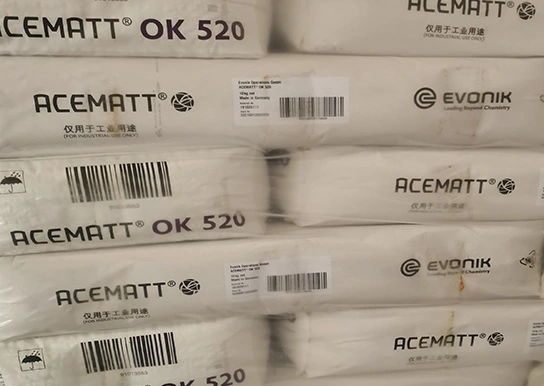
Effect of Evonik ACEMATT OK 520 CAS No. 9002-88-4
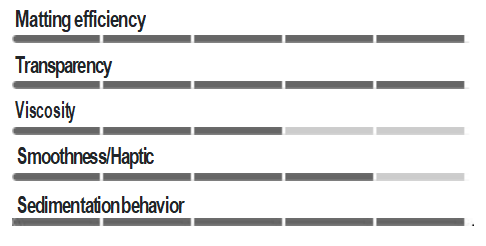
Suitability of Evonik ACEMATT OK 520 CAS No. 9002-88-4
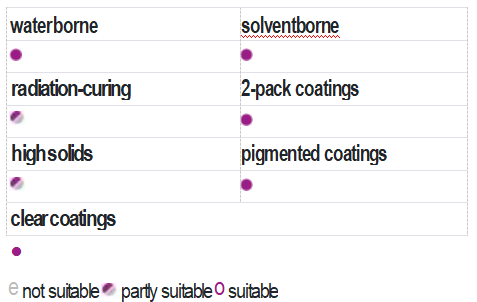
Typical Applications of Evonik ACEMATT OK 520 CAS No. 9002-88-4
Technical Data of Evonik ACEMATT OK 520 CAS No. 9002-88-4
| carbon content | 4.5% |
| DOA absorption | 300 ml/100g |
| Grindometer value | 27 µm |
| particle size, d50 | 6.5 µm |
| pH-value | 6.0 |
| specific surface area (N2) | 220 m²/g |
Recommended Addition Level of Evonik ACEMATT OK 520 CAS No. 9002-88-4
As supplied calculated on total formulation : 1.5 - 7.0 %
Processing Instructions of Evonik ACEMATT OK 520 CAS No. 9002-88-4
Addition to the coating as supplied or as a predilution is possible.
Handling& Storage of Evonik ACEMATT OK 520 CAS No. 9002-88-4
When stored in an original unopened packaging, the product has a shelf life of 24 months from the date of manufacture.
We recommend to store the product in closed containers under dry conditions and to protect the material from volatile substances.
Evonik ACEMATT OK 520 – Frequently Asked Questions (FAQ)
Q1: What is the primary function of ACEMATT OK 520 in coating and ink formulations?
A: ACEMATT OK 520 is a synthetic amorphous silica designed to provide controlled matting, improved scratch resistance, and enhanced surface texture without significantly affecting transparency or gloss uniformity in solvent-based and radiation-curable systems.
Q2: Is ACEMATT OK 520 suitable for UV-curable coatings?
A: Yes — ACEMATT OK 520 is widely used in UV-curable coatings and inks due to its excellent dispersion stability, low impact on cure speed, and compatibility with common photoinitiator systems.
Q3: How should ACEMATT OK 520 be dispersed in a formulation?
A: For optimal performance, it is recommended to disperse ACEMATT OK 520 using high-shear mixing or bead milling. Pre-wetting with compatible solvents or resins prior to incorporation helps achieve uniform distribution and minimizes agglomeration.
Q4: Does ACEMATT OK 520 affect viscosity significantly?
A: It may moderately increase system viscosity depending on dosage and base formulation, but its structured particle morphology allows for efficient rheology control at typical use levels — generally ranging from 0.1% to 2% by weight.
 English
 Español
 tiếng việt
 русский