English
 Español
 tiếng việt
 русский
The Grace silica matting series for achieving controlled gloss and surface refinement in coatings, inks, and industrial formulations. Combining amorphous silica matrices with tailored particle size distributions and surface treatments, this series ensures high matting efficiency across waterborne, solvent-based, and UV-curable systems. Products feature pore volumes ranging from 1.8 to 3.7 ml/g and pH adaptability (5.0–8.0), enabling compatibility with acid- or alkali-sensitive formulations while maintaining film clarity and scratch resistance
Organic modifications, including wax or polymer treatments, optimize dispersion stability and reduce dusting during high-shear processing. The series minimizes gloss levels below 10 GU in wood, architectural, and metal coatings, providing uniform matte finishes without compromising chemical resistance or mechanical durability.
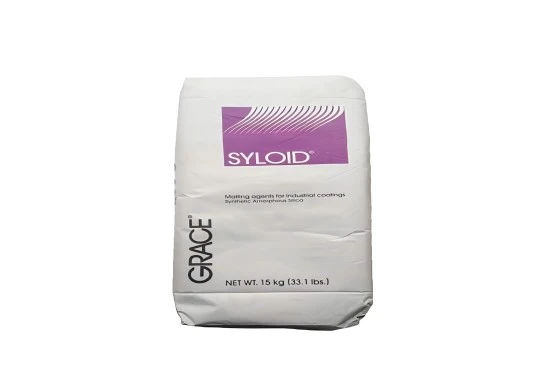
Uniform Appearance & Particle Control – Fine, white powder with optimized particle size distribution for excellent dispersion and compatibility in various systems.
Chemical Stability – Maintains performance in diverse chemical environments, including acidic/alkaline conditions, ensuring reliability in industrial processes.
Storage & Handling Efficiency – Moderate density prevents hard sedimentation, simplifies storage/transport, and ensures consistent quality over time.
Performance Preservation – No adverse effects on curing, adhesion, or mechanical properties (hardness, flexibility) while delivering high transparency.
Durability & Surface Quality – Enhances scratch resistance, abrasion resistance, and shear stability for long-lasting finishes.
High-Clarity Coatings – Ideal for transparent or matte coatings requiring optical excellence and uniform gloss control.
Industrial Finishes – Ensures durable, smooth surfaces in demanding environments (e.g., automotive, machinery).
Adhesive & Composite Systems – Improves interlayer adhesion and mechanical properties without compromising curing.
Packaging & Specialty Films – Supports scratch-resistant, low-haze surfaces for consumer and industrial packaging.
| Model | Oil Absorption (g/100g) | pH | Surface Treatment |
| C503 | 320 | 7 | Inorganic treatment |
| CP4-8991 | / | / | Wax |
| C907 | 300 | 3.3 | Wax |
| ED 50 | 300 | 7 | 10% wax |
| C807 | 320 | 3.3 | Wax |
| SY 7000 | / | / | Wax |
| ED 80 | 300 | 7 | 10% wax |
| C906 | 300 | 3.3 | wax |
Q1: What is Grace Matting Powder primarily used for?
A: Grace Matting Powder is a specialty silica-based additive designed to reduce surface gloss and improve tactile feel in coatings, inks, adhesives, and polymer systems. It functions by creating controlled light scattering at the surface, delivering consistent, non-gritty matting performance without significantly compromising film integrity or clarity.
Q2: How is Grace Matting Powder typically incorporated into formulations?
A: It is generally added during the pigment dispersion or let-down stage, using high-shear mixing to ensure uniform distribution. Pre-dispersion in a compatible solvent or resin vehicle is recommended for optimal deagglomeration. Compatibility should be verified in each specific system due to variations in polarity, viscosity, and rheology.
Q3: Does Grace Matting Powder affect transparency or haze in clear coatings?
A: When properly dispersed and used within recommended dosage ranges, it delivers effective matting with minimal impact on transparency. However, excessive loading or poor dispersion may increase haze—formulators are advised to optimize concentration and mixing parameters for each application.
Q4: Is Grace Matting Powder suitable for water-based systems?
A: Yes, it is formulated to be compatible with both solvent-borne and water-based systems, including acrylics, polyurethanes, and alkyds. Performance in aqueous media may require stabilization aids or surface treatment adjustments depending on pH and ionic strength.
Q5: How does Grace Matting Powder compare to other matting agents in terms of sedimentation stability?
A: Its engineered particle morphology and optional surface treatment help improve suspension stability relative to untreated silica grades. Nevertheless, long-term storage stability remains formulation-dependent—use of rheology modifiers or co-additives is often recommended to mitigate settling in low-viscosity systems.
Contact With Us:
E-mail: wangxingqiang@ericwchem.com
Have a Questions? Call Us:
Add:
Building A1, Jiete Industrial Park, Huangpu District, Guangzhou City, Guangdong Province, China