English
 Español
 tiếng việt
 русский
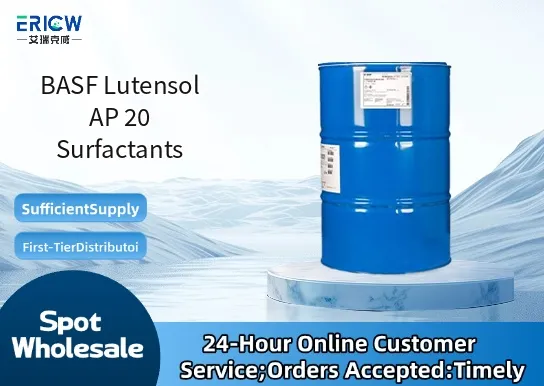
Nonionic alcohol ethoxylate with balanced hydrophilic-lipophilic character for versatile performance.
Excellent wetting, emulsifying, and dispersing properties in aqueous systems.
Good compatibility with anionic, cationic, and other nonionic surfactants.
Low foaming profile suitable for high-shear and industrial cleaning applications.
Biodegradable under aerobic conditions, supporting sustainable formulation design.
Industrial and institutional cleaners (I&I), including floor cleaners and degreasers.
Agrochemical formulations, such as emulsifiable concentrates (EC) and suspension concentrates (SC).
Textile auxiliaries for scouring, dye leveling, and pigment dispersion.
Paints and coatings as a stabilizer for pigment dispersions and latex emulsions.
Household detergents requiring low-foam, high-efficiency surfactancy.
| Chemical Type | Alcohol ethoxylate (C13–C15 linear alcohols, ~20 EO units) |
| Product Form | Liquid |
| Appearance | Pale yellow to colorless viscous liquid |
| pH (1% aqueous solution, 20 °C) | 5.5–7.0 |
| Cloud Point (1% aqueous solution) | 65–75 °C |
| Solubility | Freely soluble in water and common organic solvents |
| Active Content | 98–100 wt% |
| Key Features | Nonionic, low-foaming, thermally stable, good hard water tolerance |
Q1: What is the primary chemical nature of Lutensol AP 20?
A: Lutensol AP 20 is a nonionic surfactant based on alkylphenol ethoxylate chemistry, featuring a branched C11H23–C15H31 alkyl chain and an average of ~20 ethylene oxide units. It exhibits excellent wetting, emulsifying, and solubilizing properties in aqueous systems.
Q2: In which industrial applications is Lutensol AP 20 most commonly used?
A: It is widely employed in industrial and institutional cleaning formulations, metalworking fluids, agrochemical emulsifiable concentrates (EC), and textile auxiliaries—particularly where stable oil-in-water emulsions and low-foaming performance at elevated temperatures are required.
Q3: How does temperature affect the performance of Lutensol AP 20?
A: As a typical cloud point-type nonionic surfactant, Lutensol AP 20 exhibits reduced aqueous solubility above its cloud point (typically observed between 55–65 °C). This behavior can be leveraged for controlled phase separation in cleaning or demulsification processes, but may require formulation adjustments for high-temperature continuous-use applications.
Q4: Is Lutensol AP 20 compatible with ionic surfactants and common builders?
A: Yes—it demonstrates good compatibility with anionic surfactants (e.g., LAS, AES), cationic biocides (at appropriate pH and concentration), and inorganic builders such as sodium carbonate or sodium silicate, making it suitable for complex multi-component formulations.
Q5: What are key handling and storage recommendations for this product?
A: Store in tightly sealed containers in a cool, dry, and well-ventilated area away from direct sunlight and strong oxidizing agents. Avoid prolonged exposure to freezing temperatures, as crystallization may occur and require gentle warming to redissolve without degradation.
Contact With Us:
E-mail: wangxingqiang@ericwchem.com
Have a Questions? Call Us:
Add:
Building A1, Jiete Industrial Park, Huangpu District, Guangzhou City, Guangdong Province, China