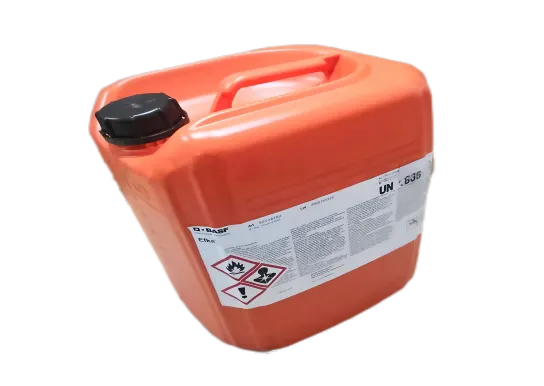
Features Of BASF Efka PX 4290 Polymer Dispersants
Universal Performance - Effective for both inorganic/organic pigments
Process Optimization - Reduces grinding time and viscosity
Color Enhancement - Maintains titanium dioxide stability
System Versatility - Compatible with solvent/water-based systems
Loading Capacity - Increases pigment/filler content
Typical Applications Of BASF Efka PX 4290 Polymer Dispersants
Automotive Refinish - Optimizes metallic pigment performance
Industrial Coatings - Enhances water/solvent-based systems
Coil Coatings - Improves TiO₂ dispersion
Composite Materials - Works in UPE copolymer systems
Architectural Coatings - Boosts dispersion efficiency
Specifications Of BASF Efka PX 4290 Polymer Dispersants
Chemical Name | Modified Polymer |
Appearance | Clear to Light Yellow Liquid |
Brand | EFKA |
Model | EFKA-PX 4290 |
Active Content | ~50% |
Solvent | Propylene Glycol Ester |
Density (20℃) | ~0.95 g/cm³ |
Acid Value | ~20 mg KOH/g |
Color | ≤9 (ISO 4630) |
Packaging | 25kg/drum |
Origin | Germany |
BASF Efka PX 4290 Polymer Dispersants – Frequently Asked Questions (FAQ)
Q1: What types of pigments is Efka PX 4290 especially effective for?
A: Efka PX 4290 is particularly effective for stabilizing high-surface-area inorganic pigments (e.g., titanium dioxide, iron oxides) and challenging organic pigments—including phthalocyanines and quinacridones—in solvent-borne and high-solids coatings systems.
Q2: How does Efka PX 4290 differ from traditional low-MW dispersants?
A: As a polymeric dispersant, Efka PX 4290 offers enhanced steric stabilization, improved long-term dispersion stability, and reduced viscosity sensitivity compared to conventional low-molecular-weight surfactants—making it suitable for demanding rheological and storage stability requirements.
Q3: Can Efka PX 4290 be used in waterborne systems?
A: Efka PX 4290 is primarily designed for solvent-borne and high-solids coating formulations. While limited compatibility may occur in some hybrid or co-solvent-containing waterborne systems, it is not recommended as a primary dispersant for fully aqueous dispersions without prior compatibility testing.
Q4: What is the typical dosage range for Efka PX 4290 in coatings formulations?
A: Dosage depends on pigment type, concentration, and system requirements, but Efka PX 4290 is typically used at low concentrations—generally ranging from 0.1% to 2% by weight relative to pigment solids—to achieve optimal wetting, dispersion, and stabilization.
Q5: Is pre-dilution required before adding Efka PX 4290 to the millbase?
A: Pre-dilution in a compatible solvent (e.g., xylene, mineral spirits, or esters) is recommended to ensure uniform incorporation and avoid localized overdosing during high-shear pigment grinding.
 English
 Español
 tiếng việt
 русский