English
 Español
 tiếng việt
 русский
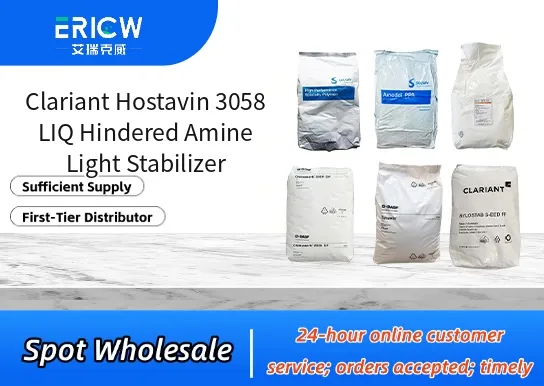
Highly effective liquid hindered amine light stabilizer (HALS) with excellent compatibility in polar and non-polar polymer systems.
Low volatility and superior thermal stability, enabling processing at elevated temperatures without significant loss or degradation.
Non-migrating and non-extractable formulation, ensuring long-term stabilization performance in demanding end-use environments.
Excellent hydrolytic stability, maintaining efficacy in humid or aqueous exposure conditions.
Easy handling and dispersion due to its low-viscosity liquid form—no melting, grinding, or pre-dilution required.
Polyolefin films and sheets (e.g., agricultural mulch, greenhouse covers, packaging).
Automotive interior plastics including PP and TPO trim components exposed to sunlight.
Coated textiles and technical fabrics requiring UV resistance under outdoor conditions.
Engineering thermoplastics such as PA6, PA66, and PBT used in exterior applications.
Water-based coatings and inks where HALS functionality must be retained without compromising formulation stability.
| Chemical Type | Hindered amine light stabilizer (HALS), tetramethylpiperidine derivative |
| Product Form | Clear to pale yellow liquid |
| Appearance | Homogeneous, mobile liquid at 20 °C |
| Primary Applications | Polyolefins, polyamides, polyesters, water-based coatings, elastomers |
| Key Features | Low volatility, high compatibility, hydrolytically stable, non-migrating |
| Benefits | Extended service life, reduced surface cracking/chalking, improved color retention |
| Recommended Dosage Range | 0.1–0.5 wt% relative to polymer or formulation |
| Storage Conditions | Store in original container below 30 °C, protect from direct sunlight and moisture |
Q1: What is the primary function of Hostavin 3058 LIQ in polymer formulations?
A: Hostavin 3058 LIQ is a liquid hindered amine light stabilizer (HALS) designed to protect polymers against photo-oxidative degradation caused by UV radiation and heat. It acts primarily through a regenerative radical scavenging mechanism, significantly extending the service life of light-exposed plastic articles.
Q2: Is Hostavin 3058 LIQ compatible with common thermoplastic resins such as polyolefins and engineering plastics?
A: Yes — Hostavin 3058 LIQ exhibits good compatibility with polyolefins (e.g., PP, HDPE, LDPE), styrenics, and certain engineering thermoplastics. Its liquid form enhances dispersion and processability during compounding or direct injection molding, reducing the risk of agglomeration compared to solid HALS alternatives.
Q3: How does the liquid format of Hostavin 3058 LIQ benefit manufacturing processes?
A: The low-viscosity liquid form enables accurate metering, homogeneous distribution in molten polymer, and simplified handling in continuous production lines. It eliminates the need for pre-blending or masterbatch dilution in many cases, supporting efficient inline dosing and reducing dust exposure during handling.
Q4: What are typical dosage guidelines for Hostavin 3058 LIQ in end-use applications?
A: Dosage depends on formulation requirements, substrate sensitivity, and expected UV exposure conditions. It is typically used at low concentrations — generally ranging from 0.1% to 2% by weight — with optimal performance often achieved in the lower half of this range for standard outdoor applications.
Q5: Can Hostavin 3058 LIQ be used in combination with other stabilizers, such as UV absorbers or antioxidants?
A: Yes — Hostavin 3058 LIQ is frequently used synergistically with UV absorbers (e.g., benzotriazoles or triazines) and phenolic or phosphite antioxidants. Such combinations provide complementary protection mechanisms and are widely applied in demanding applications like automotive exterior parts or agricultural films.
Contact With Us:
E-mail: wangxingqiang@ericwchem.com
Have a Questions? Call Us:
Add:
Building A1, Jiete Industrial Park, Huangpu District, Guangzhou City, Guangdong Province, China