English
 Español
 tiếng việt
 русский
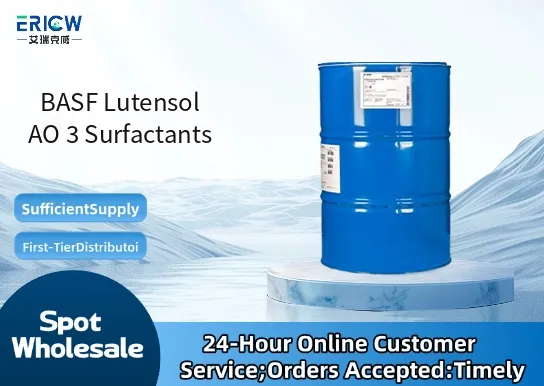
Nonionic alcohol ethoxylate with balanced hydrophilic-lipophilic character for versatile performance.
Excellent wetting and dispersing properties in aqueous systems across a broad pH range.
Low foaming profile suitable for high-shear and industrial cleaning applications.
Good biodegradability and favorable environmental profile aligned with OECD 301 standards.
Stable in hard water and compatible with common anionic, cationic, and amphoteric surfactants.
Industrial and institutional cleaners (I&I), including floor cleaners and degreasers.
Agrochemical formulations as adjuvant for improved active ingredient dispersion and foliar uptake.
Textile auxiliaries for scouring, dye leveling, and low-foam rinsing processes.
Paints and coatings as stabilizer and co-emulsifier in waterborne acrylic and alkyd systems.
Home care products such as automatic dishwashing liquids and heavy-duty laundry detergents.
| Chemical Type | Linear alcohol ethoxylate (C13–C15, ~3 mol EO) |
| Product Form | Pale yellow to colorless viscous liquid |
| Appearance (at 25 °C) | Clear, homogeneous liquid |
| Active Content (w/w %) | ≈ 100% |
| pH (1% aqueous solution) | 5.0 – 7.0 |
| Cloud Point (1% aqueous solution) | ≈ 45 – 50 °C |
| Solubility in Water | Freely soluble at room temperature |
| Primary Applications | Wetting agent, dispersant, emulsifier, and solubilizer |
Q1: What is the primary chemical nature of Lutensol AO 3?
A: Lutensol AO 3 is a nonionic surfactant based on a linear alcohol ethoxylate, specifically derived from a C12–C14 fatty alcohol with an average of approximately three ethylene oxide units. Its structure provides balanced hydrophilicity and lipophilicity, supporting effective wetting and emulsification in aqueous systems.
Q2: In which types of industrial cleaning formulations is Lutensol AO 3 most commonly applied?
A: It is widely used in low-foaming, high-efficiency industrial and institutional cleaners—especially for metal cleaning, parts washers, and hard-surface applications where rapid wetting, soil suspension, and compatibility with builders or chelants are required. Its performance remains robust across a range of pH and water hardness conditions.
Q3: How does Lutensol AO 3 compare to higher-EO analogues like Lutensol AO 5 or AO 7 in terms of foaming and solubility?
A: With fewer ethylene oxide units, Lutensol AO 3 exhibits lower aqueous solubility at ambient temperatures and reduced foaming tendency compared to AO 5 or AO 7. This makes it particularly suitable for applications requiring minimal foam and efficient rinsing, though it may require mild warming or co-solvent assistance for full dissolution in cold water.
Q4: Is Lutensol AO 3 compatible with anionic and cationic surfactants in formulated systems?
A: As a nonionic surfactant, Lutensol AO 3 generally demonstrates good compatibility with common anionic surfactants (e.g., LAS, AES) in typical cleaning concentrates. Compatibility with cationics is more formulation-dependent and should be evaluated case by case, especially under acidic or highly concentrated conditions, due to potential micellar interference or phase separation.
Contact With Us:
E-mail: wangxingqiang@ericwchem.com
Have a Questions? Call Us:
Add:
Building A1, Jiete Industrial Park, Huangpu District, Guangzhou City, Guangdong Province, China