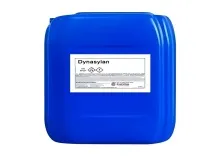
Features Of Evonik Dynasylan AMEO-T Silane Coupling Agent
Amino Functionality - Provides reactive sites for covalent bonding with multiple resin systems
Enhanced Compatibility - Improves dispersion of fillers in polymer matrices
Moisture Resistance - Maintains performance in humid environments
Thermal Stability - Withstands processing temperatures up to 217°C
Versatile Reactivity - Compatible with both thermoplastic and thermoset polymers
Typical Applications Of Evonik Dynasylan AMEO-T Silane Coupling Agent
Reinforced Plastics - Coupling agent for glass fiber reinforced composites
Adhesive Formulations - Bonding promoter in polyurethane and epoxy adhesives
Mineral-filled Compounds - Surface treatment for filled polymer systems
Casting Resins - Additive for foundry and phenolic binding applications
Coating Systems - Adhesion promoter in acrylic paints and protective coatings
Specifications Of Evonik Dynasylan AMEO-T Silane Coupling Agent
| Chemical Name | γ-Aminopropyltriethoxysilane |
| Appearance | Colorless transparent liquid |
| Specific Gravity (25°C) | 0.946 |
| Boiling Point | 217°C |
| Refractive Index | 1.420 |
| Flash Point | 96°C |
| Functionality | Amino Silane |
| Recommended Usage | 0.5-2.0% in formulations |
Evonik Dynasylan AMEO-T Silane Coupling Agent – Frequently Asked Questions (FAQ)
Q1: What is the primary functional mechanism of Dynasylan AMEO-T in composite systems?
A: Dynasylan AMEO-T acts as a bifunctional coupling agent: its alkoxy groups hydrolyze and condense with inorganic surfaces (e.g., glass, silica, metal oxides), while its amine functionality interacts with organic polymers—especially epoxy, phenolic, and polyurethane resins—enhancing interfacial adhesion and stress transfer.
Q2: How should Dynasylan AMEO-T be handled and stored to maintain stability?
A: Store in tightly sealed original containers under dry, cool conditions (below 30 °C) and protect from moisture and direct sunlight. Due to its moisture sensitivity, avoid prolonged exposure to humid air during handling; use within recommended shelf life when containers are properly resealed.
Q3: In which types of formulations is Dynasylan AMEO-T most commonly applied?
A: It is widely used in epoxy-based composites, structural adhesives, foundry binders, and mineral-filled thermosets—particularly where improved wet adhesion, mechanical strength, and long-term durability under humid or thermal stress are required.
Q4: Can Dynasylan AMEO-T be used in water-based systems?
A: Yes—Dynasylan AMEO-T can be incorporated into aqueous dispersions or emulsions, but requires careful pre-hydrolysis and pH control (typically mild acidic conditions) to ensure colloidal stability and prevent premature condensation.
Q5: How does Dynasylan AMEO-T compare to other amino-silanes in terms of reactivity and compatibility?
A: Its tertiary amine structure provides lower basicity and reduced catalytic activity toward epoxy ring-opening compared to primary amino-silanes like Dynasylan AMEO, offering better pot-life control in reactive resin systems while still delivering strong interfacial bonding.
 English
 Español
 tiếng việt
 русский