English
 Español
 tiếng việt
 русский
Chemours Titanium Dioxide series comprises chloride-processed rutile pigments engineered for high-performance applications across coatings, plastics, and specialty industries. Leveraging advanced surface treatment technologies, these pigments deliver exceptional light-scattering efficiency, ensuring superior opacity and brightness while minimizing material usage.
Optimized for durability, the series features tailored inorganic and organic coatings that enhance UV stability, reduce photocatalytic activity, and improve compatibility with diverse matrices. Their controlled particle size distribution maximizes dispersion efficiency in both solvent- and water-based systems, enabling seamless integration into architectural paints, automotive coatings, and industrial finishes.
While specialized treatments minimize interactions with polymer additives, preserving melt-flow properties during high-temperature processing.
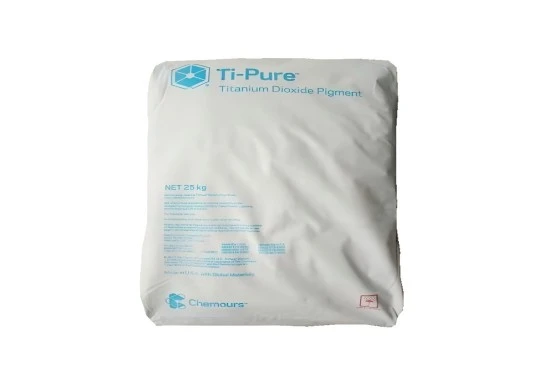
Premium Rutile-Grade Pigment – Produced via advanced chloride process for high purity and consistent performance.
Superior Optical Properties – Exceptional opacity, brightness, and optimized undertones (blue/neutral) for vibrant coloration.
Enhanced Stability – Surface treatments (silica, organic coatings) minimize UV degradation and improve dispersion.
Efficient Formulation – High tinting strength reduces required dosage while maintaining coverage and durability.
Low Abrasion & Processing Ease – Smooth texture ensures excellent flow and compatibility in various matrices.
Coatings – Architectural, industrial, and automotive paints for high coverage, weather resistance, and gloss retention.
Plastics – PVC, PE, PP, ABS for whiteness, UV stability, and long-term color retention in outdoor applications.
Inks & Paper – Enhances opacity, brightness, and print quality in inks and paper products.
Specialty Applications – Rubber, cosmetics, and other industries requiring safe, high-performance white pigments.
| Model | Aluminum Oxide (wt%) | Organic Treatment (wt%) | Specific Gravity | pH (Aqueous Slurry) | Resistivity (kΩ·cm, min) |
| R104 | 1.7 (min) | 0.3 | 4.2 | 6.5 | 4 |
| R105 | ≤ 3.2 (max) | 0.2 | 4 | 6.5 | 4 |
| R101 | 3.2 (min) | 0.2 | 4.1 | 6.5 | 4 |
| R931 | 3.2 (min) | 0.2 | 4.1 | 6.5–8.0 | 4 |
| TS-6200 | / | 0 | 3.9 | 7.2 | 6 |
Q1: What are the primary grades of Chemours titanium dioxide and how do they differ?
A: Chemours offers a range of TiO₂ pigments—including R-900 series for high-performance coatings, R-960 for demanding plastics applications, and the ultrafine T-LITE® line for transparent or UV-absorbing systems. Differences lie in surface treatment chemistry, particle size distribution, and dispersion characteristics—each optimized for specific end-use requirements such as durability, gloss retention, or optical clarity.
Q2: How does surface treatment affect performance in polymer systems?
A: Surface treatments—typically combinations of alumina, silica, and organic modifiers—enhance compatibility with polymer matrices, improve dispersion stability during melt processing, and reduce photocatalytic activity. This helps maintain color consistency, mechanical integrity, and long-term weatherability in applications like PVC profiles, polyolefins, and engineering thermoplastics.
Q3: Is Chemours titanium dioxide suitable for food-contact plastics?
A: Certain Chemours TiO₂ grades are manufactured and qualified for use in food-contact plastics under applicable global regulatory frameworks, including FDA 21 CFR and EU Regulation (EC) No 1935/2004. Formulators should verify grade-specific compliance documentation and ensure final application conditions (e.g., temperature, contact time) align with intended use.
Q4: What is the typical dosage range for titanium dioxide in industrial coatings?
A: Dosage depends on formulation goals—including opacity, tinting strength, and substrate coverage—but generally ranges from 0.1% to 2% by weight in high-solids architectural coatings, and may extend higher in specialty industrial finishes where maximum hiding power or whiteness is critical. Optimization requires balancing pigment loading with rheology, film formation, and cost-effectiveness.
Contact With Us:
E-mail: wangxingqiang@ericwchem.com
Have a Questions? Call Us:
Add:
Building A1, Jiete Industrial Park, Huangpu District, Guangzhou City, Guangdong Province, China