English
 Español
 tiếng việt
 русский
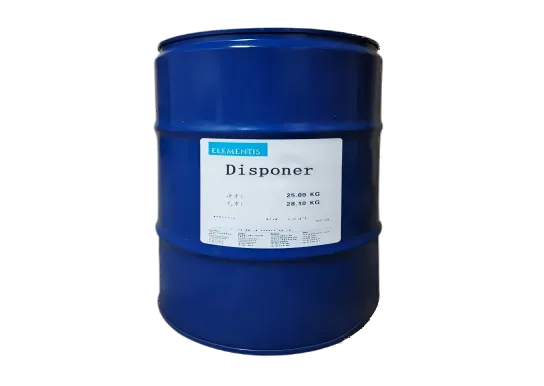
Elementis Deqian Disponer 983 is a professional polymeric wetting dispersant for medium and high polar solvent-based systems under Elementis Deqian, specially designed for the dispersion of organic, inorganic pigments and high-grade carbon black. Relying on the structural advantages of polymeric chelates, it has strong adsorption to pigments
Strong adsorption and anti-flocculation - Multiple adsorption groups with high affinity, thick adsorption layer strongly inhibits pigment flocculation
Excellent system compatibility - Resin-like structure without free migration, no impact on film adhesion and water/weather resistance
Wide dispersion adaptability - Compatible with medium and high polar systems, suitable for organic, inorganic pigments and high-grade carbon black
Good performance stability - Ensures stable storage of color pastes and coatings, maintains uniform viscosity and fineness of the system
Excellent color development effect - Improves pigment color rendering, ensures uniform film color without defects
Alkyd/amino resin coatings - Medium and high polar alkyd amino systems, improve pigment dispersion stability
Polyester polyurethane coatings - Polyester polyurethane anti-corrosion and decorative coatings, ensure comprehensive film performance
Acrylic polyurethane coatings - Acrylic polyurethane industrial coatings, optimize pigment color development and storage
Solvent-based gravure inks - Medium and high polar gravure inks, improve printing color and pattern clarity
Solvent-based screen inks - Screen printing inks, improve ink fluidity and printing adaptabilit
| Brand | Elementis Deqian |
| Chemical Type | Polymeric chelate wetting and dispersing agent |
| Chemical Composition | Polymeric chelate |
| Appearance (25°C) | Light brown liquid |
| Non-volatile Content | 52.5-54.5% |
| Solvent | Xylene / Butyl acetate |
| Specific Gravity (25°C) | 0.95-0.99 |
| Acid Value | 5 mgKOH/g |
| Refractive Index (25°C) | 1.470-1.480 |
Q1: What types of pigment systems is Disponer 983 especially effective for?
A: Disponer 983 is particularly effective for wetting and dispersing inorganic pigments such as titanium dioxide, iron oxides, and carbon black, as well as many organic pigments commonly used in architectural, industrial, and protective coatings.
Q2: How does Disponer 983 contribute to improved coating stability?
A: It enhances colloidal stability by reducing interfacial tension and providing steric stabilization, helping to minimize pigment flocculation, settling, and viscosity drift during storage—especially in water-based systems with high pigment loading.
Q3: Is Disponer 983 compatible with common co-dispersants or rheology modifiers?
A: Yes, it shows good compatibility with a broad range of associative and non-associative thickeners, as well as other polymeric dispersants and surfactants typically used in low-VOC and zero-VOC aqueous formulations.
Q4: What is the recommended addition method for optimal performance?
A: For best results, Disponer 983 should be added during the initial pigment wetting stage—preferably before or concurrently with pigment incorporation—and mixed thoroughly under moderate shear to ensure uniform contact with particle surfaces.
Q5: Can Disponer 983 be used in both ambient-cure and baked systems?
A: Yes, it is thermally stable enough for use in ambient-cure architectural paints as well as low-bake industrial coatings, maintaining performance across typical processing and film-formation conditions without significant degradation or volatilization.
Contact With Us:
E-mail: wangxingqiang@ericwchem.com
Have a Questions? Call Us:
Add:
Building A1, Jiete Industrial Park, Huangpu District, Guangzhou City, Guangdong Province, China