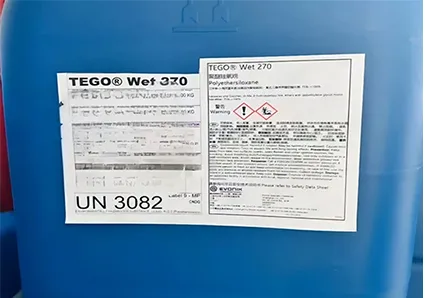
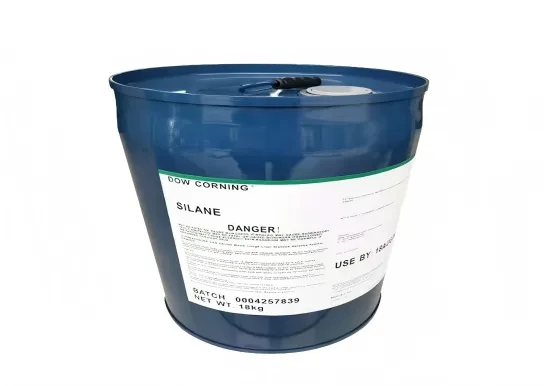
Dow Corning OFS-6030 (γ-methacryloxypropyltrimethoxysilane) is a bifunctional silane coupling agent that enhances adhesion between organic resins (polyester, acrylic) and inorganic substrates (glass fibers, metals). It forms durable siloxane crosslinks, improving wet adhesion (>90% retention) and mechanical strength in composites. Ideal for FRP, coatings, and cables, it complies with REACH/RoHS and enables fast curing at ambient temperatures
Interfacial Reinforcement - Methacryloxy groups copolymerize with resins; methoxy links to fillers/fibers, optimizing stress transfer
Process Efficiency - Lowers viscosity (1.040–1.053 g/cm³) for homogeneous filler dispersion
Durability - Enhances UV/aging resistance in coatings (salt spray resistance >1,000 hours)
Multi-Matrix Compatibility - Works with polyester, epoxy, and polyurethane resins
FRP Composites - Glass fiber sizing for automotive parts (30–50% strength increase)
Wire Insulation - Crosslinked polyethylene cables with improved dielectric properties
Industrial Coatings - Metal primers with enhanced corrosion resistance
Adhesives - Acrylic formulations with 0-level adhesion (ASTM D3359)
Chemical Name | Methacryloxypropyltrimethoxysilane |
Appearance | White to light yellow liquid |
Kinematic Viscosity (25℃) | 2.5 cSt |
Specific Gravity (25℃) | 1.04 |
Flash Point (Closed Cup) | 138℃ |
Purity | ≥98% |
Refractive Index (25℃) | 1.43 |
Boiling Point (760mm Hg) | 190℃ |
Molecular Weight | 248.35 g/mol |
Packaging | 200KG/drum |
Q1: What is the primary function of OFS-6030 in composite formulations?
A: OFS-6030 is a silicate-based coupling agent designed to enhance interfacial adhesion between inorganic fillers (e.g., silica, alumina, calcium carbonate) and organic polymer matrices, improving mechanical properties, moisture resistance, and long-term durability of filled systems.
Q2: Is OFS-6030 compatible with common thermoset resins such as epoxy, phenolic, and silicone?
A: Yes, OFS-6030 demonstrates broad compatibility with thermosetting resins including epoxy, phenolic, melamine, and silicone systems. Its hydrolytically stable silicate structure allows for effective incorporation during compounding or pre-mixing without premature condensation or viscosity instability.
Q3: How should OFS-6030 be incorporated into a formulation for optimal performance?
A: It is typically added directly to the filler surface via dry blending or pre-treated in solution prior to mixing with the resin. For best results, ensure uniform dispersion and allow sufficient residence time for surface interaction—dosage depends on formulation requirements but generally ranges from 0.1% to 2% by weight relative to filler mass.
Q4: Does OFS-6030 require hydrolysis or activation before use?
A: Unlike many alkoxysilanes, OFS-6030 is supplied as a pre-hydrolyzed, stable silicate solution and does not require separate acid- or water-catalyzed activation. This simplifies handling and improves process robustness in high-shear or moisture-sensitive operations.
Contact With Us:
E-mail: wangxingqiang@ericwchem.com
Have a Questions? Call Us:
Add:
Building A1, Jiete Industrial Park, Huangpu District, Guangzhou City, Guangdong Province, China
 English
 Español
 tiếng việt
 русский