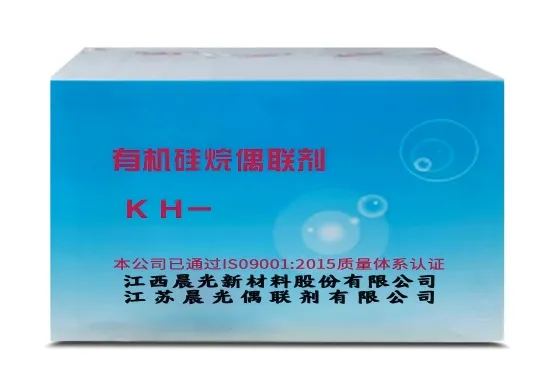
Features Of Chenguang KH-560 Silane Coupling Agent
Interfacial Reinforcement - Epoxy groups bond with resins; methoxy links to fillers/fibers, optimizing stress transfer .
Process Efficiency - Lowers viscosity (1.065–1.075 g/cm³) for homogeneous filler dispersion
Durability - Enhances UV/aging resistance in coatings (salt spray resistance >1,000 hours)
Multi-Matrix Compatibility - Works with epoxy, polyurethane, and nylon resins
Typical Applications Of Chenguang KH-560 Silane Coupling Agent
FRP Composites - Glass fiber sizing for automotive parts (30% strength increase) .
Electronics - Epoxy-based sealants with improved dielectric properties .
Industrial Coatings - Metal primers with enhanced corrosion resistance
Adhesives - Polysulfide/polyurethane formulations for aerospace .
Specifications Of Chenguang KH-560 Silane Coupling Agent
Chemical Name | γ-Glycidoxypropyltrimethoxysilane |
Appearance | Colorless to light yellow transparent liquid |
Molecular Weight | 236.34 g/mol |
Specific Gravity (25℃) | 1.065-1.072 |
Boiling Point | 290℃ |
Flash Point (Closed Cup) | >101℃ |
Active Content | >98.5% |
Viscosity (25℃) | 3.0 cSt |
Packaging | 200KG/drum |
Chenguang KH-560 Silane Coupling Agent – Frequently Asked Questions (FAQ)
Q1: What is the primary functional advantage of KH-560 in composite formulations?
A: KH-560 features both an epoxy-functional group and a hydrolyzable alkoxy group, enabling it to chemically bridge inorganic fillers (e.g., silica, glass fibers) and organic polymer matrices (e.g., epoxies, polyurethanes, acrylics), thereby enhancing interfacial adhesion, mechanical strength, and moisture resistance.
Q2: How should KH-560 be handled and stored to maintain stability?
A: KH-560 should be stored in tightly sealed containers under dry, cool conditions (below 30°C), protected from moisture and direct sunlight. It is hygroscopic and may undergo premature hydrolysis if exposed to ambient humidity for extended periods; therefore, opened containers should be used promptly or purged with dry nitrogen.
Q3: Can KH-560 be used directly in aqueous systems?
A: KH-560 is not water-soluble and requires pre-hydrolysis in a water/alcohol mixture (e.g., ethanol/water, pH adjusted to 4–5 with acetic acid) to form a stable silanol solution prior to addition into aqueous-based coatings, adhesives, or mineral slurries.
Q4: What types of fillers or substrates show the strongest compatibility with KH-560?
A: KH-560 demonstrates excellent coupling performance with silica-based materials (fumed silica, precipitated silica), glass fibers, talc, and metal oxides (e.g., alumina, zinc oxide). It is especially effective in epoxy composites, UV-curable acrylates, and rubber-to-metal bonding applications where epoxy reactivity aligns with the matrix chemistry.
Q5: Is KH-560 suitable for high-temperature curing processes?
A: Yes — KH-560 forms thermally stable siloxane bonds upon curing, and its epoxy functionality remains reactive through typical thermal cure cycles up to approximately 180°C, making it compatible with standard epoxy and phenolic resin processing conditions.
 English
 Español
 tiếng việt
 русский