Features Of Honeywell Polyethylene Homopolymer Wax Powder ACumist B-12
Chemical Resistance: Stable in solvents/UV systems (25°C) without dissolution
Adhesion Boost: 30% improved coating-substrate bonding (ASTM D3359)
Flow Enhancement: Reduces ink viscosity by 20% for better printability
Multi-Application: Compatible with coatings, dyes, paints and flexo inks
Eco-Compliant: REACH & RoHS certified,<0.1% VOC content
Easy Processing: 5-7μm particles ensure rapid dispersion
Typical Applications Of Honeywell Polyethylene Homopolymer Wax Powder ACumist B-12
Industrial Coatings: Enhances metal/plastic coating durability
Packaging Inks: Improves flexo ink transfer and rub resistance
Decorative Paints: Optimizes leveling and color consistency
Plastic Modification: Flow aid for filled composites
Specifications Of Honeywell Polyethylene Homopolymer Wax Powder ACumist B-12
Chemical Type | Polyethylene Homopolymer Wax Powder |
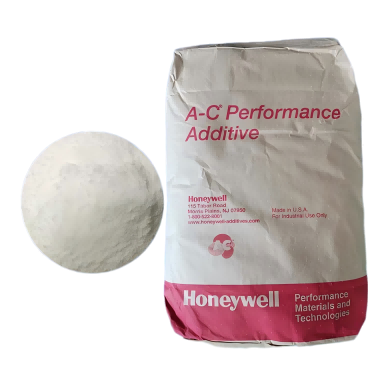
Appearance | White Powder |
Brand | Honeywell |
Model | ACumist B-12 |
Melting Point | Approx. 105-115℃ |
Density | 0.93 g/cm³ |
Packaging | 20kg/bag |
Origin | USA |
Honeywell Polyethylene Homopolymer Wax Powder ACumist B-12 – Frequently Asked Questions (FAQ)
Q1: What is the primary function of ACumist B-12 in coating and ink formulations?
A: ACumist B-12 functions primarily as a matting agent and surface modifier, providing controlled gloss reduction, improved scratch resistance, and enhanced slip characteristics without significantly affecting film clarity or adhesion.
Q2: Is ACumist B-12 compatible with water-based systems?
A: Yes, ACumist B-12 is widely used in both solvent-based and water-based coatings and inks. Its hydrophobic polyethylene surface may require appropriate dispersing agents or high-shear dispersion for stable incorporation into aqueous systems.
Q3: How does ACumist B-12 differ from copolymer wax powders in performance?
A: As a homopolymer wax, ACumist B-12 offers higher crystallinity and melting point consistency compared to ethylene-acrylic acid or ethylene-vinyl acetate copolymers, resulting in more predictable melt behavior and superior thermal stability in high-temperature processing applications.
Q4: What is the recommended method for incorporating ACumist B-12 into polymer melts or viscous resins?
A: For melt compounding, pre-blending with carrier resin or using side-feed extrusion is advised to ensure uniform distribution. In high-viscosity liquid systems, gradual addition under high-shear mixing—followed by extended dispersion—is typically required to avoid agglomeration.
Q5: Can ACumist B-12 be used in food-contact compliant coatings?
A: ACumist B-12 is designed for industrial and functional applications; its suitability for food-contact use depends on final formulation compliance and regulatory evaluation by the end-user. Honeywell does not certify this grade for direct food-contact applications without further qualification.
 English
 Español
 tiếng việt
 русский