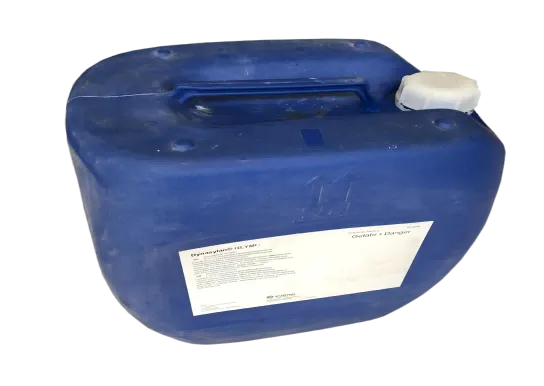
Features Of Evonik Dynasylan 1175 Cationic Aminosilane
Dual Reactivity – Features vinyl and amino groups for broad polymer compatibility
Cationic Nature – Provides inherent antistatic properties and excellent resin wetting
Instant Water Solubility – Fully miscible in water even at neutral pH
Extended Gel Time – High chloride content delays epoxy curing, reducing air entrapment
Typical Applications Of Evonik Dynasylan 1175 Cationic Aminosilane
Fiber Reinforcements – Glass fiber sizing for epoxy and unsaturated polyester composites
Adhesive Systems – Primer and additive for sealants and adhesives
Conductive Coatings – Antistatic modifier in paints and protective coatings
Mineral-Filled Composites – Pretreatment agent for fillers and pigments
Electronics Encapsulation – Enhanced dielectric properties in epoxy potting systems
Specifications Of Evonik Dynasylan 1175 Cationic Aminosilane
| Chemical Type | Cationic Amino Silane |
| Active Content | 40% in Methanol |
| Appearance | Dark yellow to brown liquid |
| Reactivity | Vinyl & Amino groups |
| Solubility | Water-miscible (pH 7) |
| Recommended Hydrolysis | Acetic acid (pH 3-4) |
| Key Feature | Antistatic, Gel time extension |
| Shelf Life | 1 year (sealed) |
Evonik Dynasylan 4148 Nonionic Polyether Silane – Frequently Asked Questions (FAQ)
Q1: What is the primary function of Dynasylan 4148 in coating and adhesive formulations?
A: Dynasylan 4148 acts as a nonionic coupling agent and surface modifier, enhancing interfacial adhesion between inorganic substrates (e.g., glass, metals, minerals) and organic polymer matrices. Its polyether structure imparts water dispersibility and compatibility with polar resins, while the silane moiety enables covalent bonding to silica-rich surfaces.
Q2: Is Dynasylan 4148 suitable for use in aqueous systems?
A: Yes — its nonionic polyether architecture provides good water dispersibility and stability in neutral to mildly alkaline aqueous dispersions, making it well-suited for waterborne coatings, cementitious admixtures, and latex-based adhesives without requiring acid catalysis or extensive pH adjustment.
Q3: How does Dynasylan 4148 differ from amino- or mercapto-functional silanes?
A: Unlike cationic amino-silanes or sulfur-containing variants, Dynasylan 4148 is nonionic and non-reactive toward epoxies or acrylates under ambient conditions. This offers greater formulation flexibility, reduced risk of premature crosslinking, and improved compatibility with sensitive resin systems such as polyurethanes and unsaturated polyesters.
Q4: What are typical dosage guidelines for Dynasylan 4148 in industrial applications?
A: Dosage depends on substrate surface area, formulation polarity, and performance targets, but it is typically used at low concentrations — generally ranging from 0.1% to 2% by weight relative to the total solids or filler content. Optimization through lab-scale trials is recommended to balance adhesion enhancement and cost efficiency.
Q5: Can Dynasylan 4148 improve moisture resistance in filled composites?
A: Yes — by promoting stronger siloxane bonds at the filler–polymer interface and reducing hydrophilic pathways, it contributes to improved moisture resistance and long-term durability in mineral-filled polymers, especially under cyclic humidity or immersion conditions.
 English
 Español
 tiếng việt
 русский