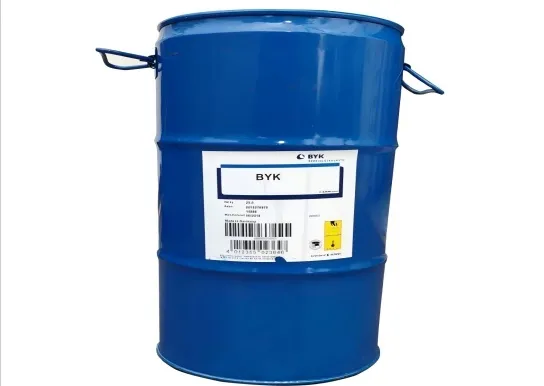
Effect of BYK DISPERBYK-2012 Wetting Dispersing Agents
Universal Compatibility - Works with cationic binders and diverse additives (amines, surfactants) without performance loss
Emission Control - Solvent/VOC-free formulation meets stringent environmental standards
Multi-Pigment Stability - Prevents flocculation in transparent/opaque organic pigments and carbon black
Process Adaptability - Effective in both resin-containing and resin-free grinding systems
Performance Enhancement - Improves color strength, gloss, and storage stability through steric stabilization
Typical Applications of BYK DISPERBYK-2012 Wetting Dispersing Agents
Automotive OEM - Waterborne basecoats requiring color consistency
Industrial Coatings - Machinery finishes with high pigment loading
Road Marking Paints - Aqueous traffic line formulations
Wood Coatings - Low-VOC furniture finishes with cationic binders
Flexographic Inks - Packaging inks needing stable pigment dispersion
Technical Data of BYK DISPERBYK-2012 Wetting Dispersing Agents
| Chemical Base | CPT-based copolymer with pigment-affinic groups |
| Density (20°C) | 1.06 g/ml |
| Amine Value | 7 mg KOH/g |
| Storage Handling | Requires 20°C homogenization if stored below 5°C |
| Regulatory Status | Complies with AgBB emission standards |
BYK DISPERBYK-142 Wetting Dispersans Agents – Frequently Asked Questions (FAQ)
Q1: What is the primary function of DISPERBYK-142 in pigment dispersion systems?
A: DISPERBYK-142 is a low-viscosity, solvent-based wetting and dispersing additive designed to enhance pigment deagglomeration, improve stabilization against flocculation, and reduce viscosity in organic pigment systems—particularly in medium- to high-polarity solventborne coatings and printing inks.
Q2: Is DISPERBYK-142 suitable for waterborne systems?
A: No—DISPERBYK-142 is specifically formulated for solventborne applications and is not compatible with water-based or high-water-content systems. For aqueous dispersions, BYK recommends alternatives such as DISPERBYK-2012 or DISPERBYK-190.
Q3: How should DISPERBYK-142 be incorporated into a formulation?
A: It is typically added during the pigment grinding stage, directly to the millbase, to ensure optimal wetting before particle size reduction. Pre-dilution with compatible solvents may be used to facilitate uniform distribution, especially in highly viscous systems.
Q4: Which pigment types show the strongest performance response with DISPERBYK-142?
A: It delivers particularly effective stabilization for organic pigments—including phthalocyanines, quinacridones, and diketopyrrolopyrroles—as well as certain inorganic pigments like iron oxides, especially in aromatic and ketonic solvent systems.
Q5: Can DISPERBYK-142 help reduce grinding time and energy consumption?
A: Yes—by accelerating pigment wetting and improving interfacial contact between the liquid phase and solid particles, it often enables shorter dispersion cycles and lower mechanical energy input while achieving target fineness and color strength.
 English
 Español
 tiếng việt
 русский