English
 Español
 tiếng việt
 русский
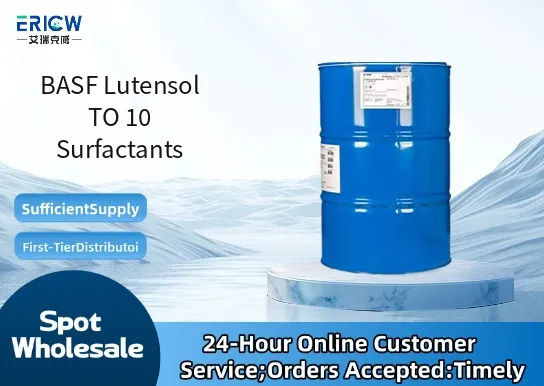
Nonionic surfactant based on linear alcohol ethoxylate (C13–C15) with balanced hydrophilic-lipophilic properties.
Excellent wetting, emulsifying, and solubilizing performance in both hard and soft water.
Good low-temperature stability and compatibility with anionic, cationic, and other nonionic surfactants.
Biodegradable formulation meeting OECD 301 standards for ready biodegradability.
Low foaming profile suitable for high-speed industrial cleaning and rinse applications.
Industrial and institutional cleaners (I&I), including floor cleaners and degreasers.
Textile auxiliaries for scouring, dye leveling, and dispersion stabilization.
Agrochemical formulations as emulsifier and solubilizer for EC and SE concentrates.
Paints and coatings for pigment wetting and latex stabilization.
Home care products such as all-purpose cleaners and dishwashing liquids.
| Chemical Type | Linear alcohol ethoxylate (C13–C15, avg. 10 mol EO) |
| Product Form | Liquid |
| Appearance | Pale yellow to colorless, clear liquid |
| pH (1% aqueous solution, 20 °C) | 5.5–7.0 |
| Cloud Point (1% aqueous solution) | 58–62 °C |
| Active Content (wt. %) | 99.0–100.0 |
| Density (20 °C) | 0.99–1.01 g/cm³ |
| Solubility | Freely soluble in water and common organic solvents |
Q1: What is the primary chemical nature of Lutensol TO 10?
A: Lutensol TO 10 is a nonionic surfactant based on linear alcohol ethoxylates, specifically derived from C10–C12 fatty alcohols with an average of approximately 10 moles of ethylene oxide per molecule. Its structure provides balanced hydrophilic-lipophilic properties suitable for emulsification, solubilization, and detergency in industrial formulations.
Q2: In which types of industrial cleaning applications is Lutensol TO 10 commonly used?
A: It is widely employed in low-foaming, high-efficiency industrial and institutional cleaners—especially for hard-surface cleaning, metal parts degreasing, and CIP (clean-in-place) systems—where stable emulsification of oils and greases at elevated temperatures and varying water hardness is required.
Q3: How does Lutensol TO 10 perform in hard water conditions?
A: As a nonionic surfactant, Lutensol TO 10 maintains good performance in moderately hard water, with minimal sensitivity to calcium and magnesium ions compared to anionic surfactants. Its effectiveness may be further enhanced when combined with appropriate chelating agents in demanding formulations.
Q4: Is Lutensol TO 10 suitable for low-temperature cleaning processes?
A: Yes—it exhibits favorable solubility and surface activity at room temperature and below, making it well-suited for cold-water or ambient-temperature cleaning applications where energy efficiency is prioritized, without compromising cleaning efficacy on light-to-moderate soils.
Q5: What are typical dosage guidelines for Lutensol TO 10 in formulated cleaners?
A: Dosage depends on formulation requirements and soil type, but it is typically used at low concentrations—generally ranging from 0.1% to 2% by weight—in ready-to-use or concentrate systems. Optimal levels should be determined through application-specific testing to balance performance, foam control, and cost-effectiveness.
Contact With Us:
E-mail: wangxingqiang@ericwchem.com
Have a Questions? Call Us:
Add:
Building A1, Jiete Industrial Park, Huangpu District, Guangzhou City, Guangdong Province, China