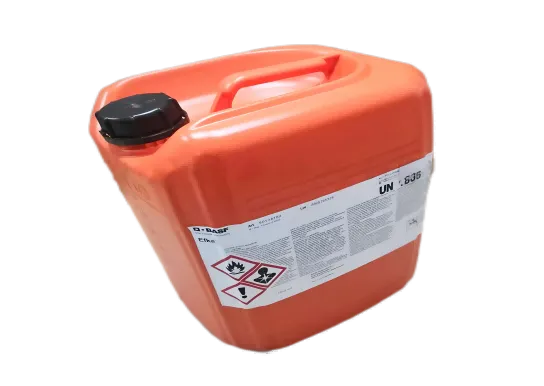
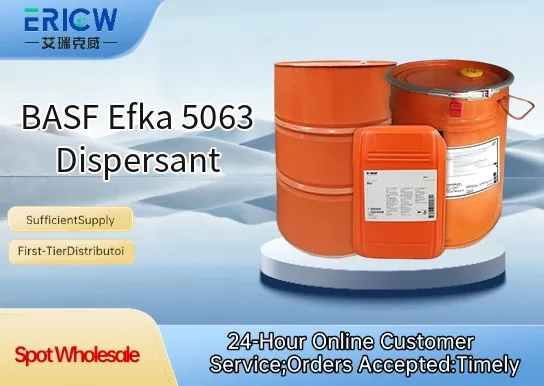
Features Of BASF Efka 5065 Silicone-Enhanced Carboxylate Dispersants
Dual-Action Formula - Combines carboxylate & silicone technologies
Surface Perfection - Achieves ≥85° gloss (20°) and superior smoothness
Process Efficiency - Cuts grinding time by 30-50%
Universal Compatibility - Works with NC, PU, alkyd-amine systems
Color Integrity - Maintains consistent hue development
Typical Applications Of BASF Efka 5065 Silicone-Enhanced Carboxylate Dispersants
Nitrocellulose Lacquers - For high-gloss wood/furniture finishes
Baking Enamels - Enhances weather-resistant industrial coatings
2K PU Coatings - Improves automotive/industrial durability
Chlorinated Rubber - Optimizes marine/anti-corrosive paints
Specifications Of BASF Efka 5065 Silicone-Enhanced Carboxylate Dispersants
Chemical Name | Unsaturated Carboxylate + Silicone |
Appearance | Transparent Yellowish Liquid |
Brand | EFKA |
Model | EFKA-5065 |
Active Content | 50–54% |
Solvent | Alkylbenzene/Diisobutyl Ketone |
Density (20°C) | 0.94–0.96 g/cm³ |
Acid Value | 100–140 mg KOH/g |
Flash Point | 40°C |
Packaging | 20kg, 200kg Iron Drum |
Origin | Germany |
BASF Efka 5065 Silicone-Enhanced Carboxylate Dispersants – Frequently Asked Questions (FAQ)
Q1: What is the primary functional benefit of the silicone enhancement in Efka 5065?
A: The silicone modification significantly improves substrate wetting and interfacial stabilization, particularly on low-energy surfaces such as polyolefins and fluorinated substrates, while maintaining strong pigment anchoring via the carboxylate group.
Q2: In which types of coating systems is Efka 5065 most commonly used?
A: It is widely employed in solventborne and high-solids industrial coatings, including coil coatings, automotive refinish, and general metal protective coatings—especially where enhanced flow, leveling, and pigment deagglomeration are required alongside improved substrate adhesion.
Q3: How does Efka 5065 differ from conventional carboxylate dispersants without silicone functionality?
A: Unlike standard carboxylate dispersants, Efka 5065 combines dual-mode stabilization: the carboxylate moiety provides electrostatic and steric anchoring to polar pigment surfaces, while the silicone segment delivers superior surface migration and dynamic interfacial activity—resulting in more robust dispersion stability and reduced surface defects.
Q4: Is Efka 5065 compatible with common crosslinkers used in thermosetting systems?
A: Yes, Efka 5065 demonstrates good compatibility with melamine-formaldehyde, urea-formaldehyde, and blocked isocyanate crosslinkers under typical formulation and curing conditions; however, pre-testing in the final system is recommended to confirm stability and performance.
Q5: What is the typical dosage range for Efka 5065 in pigment concentrates?
A: Dosage generally ranges from 0.1% to 2% by weight relative to pigment, depending on pigment type, loading level, and desired dispersion quality; optimal use is typically determined through lab-scale dispersion trials and rheological evaluation.
 English
 Español
 tiếng việt
 русский