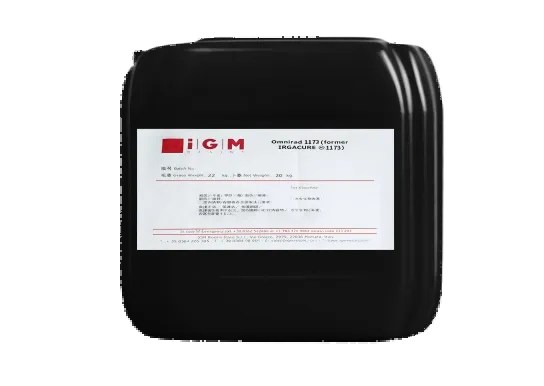
Features Of IGM Omnirad 754 Photoinitiator
Efficient liquid initiation - Liquid easy to add and mix, rapidly initiates polymerization under UV, excellent curing efficiency
Low yellowing and weatherability - Minimal yellowing after curing, anti-yellowing performance can be further improved with light stabilizers
Low odor and low exotherm - Low residual odor and less curing exotherm, enhancing construction safety and user experience
Broad system compatibility - Suitable for most organic solvents and acrylate systems, strong versatility
Excellent compounding performance - Can be compounded with other photoinitiators to optimize through-cure and surface curing effects
Typical Applications Of IGM Omnirad 754 Photoinitiator
Wood clear varnish - UV transparent coating for wood surfaces, ensuring long-lasting transparency and improving texture
Plastic clear coating - Clear varnish for plastic substrates, suitable for various plastics, scratch-resistant and non-yellowing
Transparent printing ink - Low odor and low yellowing, suitable for food packaging-related transparent ink printing
UV curing adhesive - Low exotherm and low odor, suitable for precision bonding scenarios with excellent bonding strength
Optical coating - Suitable for surface coating of optical components, low yellowing without affecting optical performance
Specifications Of IGM Omnirad 754 Photoinitiator
| CAS No | 211510-16-6;442536-99-4 |
| Appearance (25℃) | Light yellow liquid |
| Molecular Weight | Approx. 370.35 g/mol |
| Density (20℃) | 1.22 g/mL |
| Viscosity (20℃) | 84 mPa·s |
| Melting Point | <-22℃ |
| Absorption Peaks | 255nm, 325nm (in methanol) |
| Purity | ≥98% |
IGM Omnirad 754 Photoinitiator – Frequently Asked Questions (FAQ)
Q1: What is the primary photoreactivity profile of Omnirad 754?
A: Omnirad 754 is a Type II photoinitiator based on a benzophenone derivative, requiring a co-initiator (e.g., tertiary amine) to generate reactive species under UV-A and visible light exposure. It exhibits strong absorption in the 320–400 nm range and is especially effective in low-intensity or LED-curing systems.
Q2: Is Omnirad 754 suitable for food-contact or medical-grade formulations?
A: Omnirad 754 is designed for industrial and specialty coatings applications. While it may be incorporated into certain regulated systems, its suitability for food-contact or medical use depends entirely on final formulation validation, regulatory review, and compliance with applicable regional requirements — IGM does not provide pre-approved status for such applications.
Q3: How does Omnirad 754 compare to traditional benzophenone initiators in terms of yellowing and surface cure?
A: Compared to standard benzophenones, Omnirad 754 offers reduced tendency toward post-cure yellowing and improved surface reactivity—particularly beneficial in clear coatings and pigmented systems where gloss retention and through-cure are critical.
Q4: What solvents or resin systems is Omnirad 754 typically compatible with?
A: Omnirad 754 demonstrates good solubility and stability in common UV-curable acrylate oligomers and monomers, as well as in solvent-based acrylic, polyester, and epoxy systems. Compatibility should always be confirmed experimentally due to potential interactions with additives or acidic components.
Q5: What is the typical dosage range for effective initiation in UV-curable formulations?
A: Dosage depends on formulation composition, film thickness, irradiation source, and desired cure speed—but Omnirad 754 is generally used at low concentrations, typically ranging from 0.1% to 2% by weight relative to total formulation solids.
 English
 Español
 tiếng việt
 русский