English
 Español
 tiếng việt
 русский
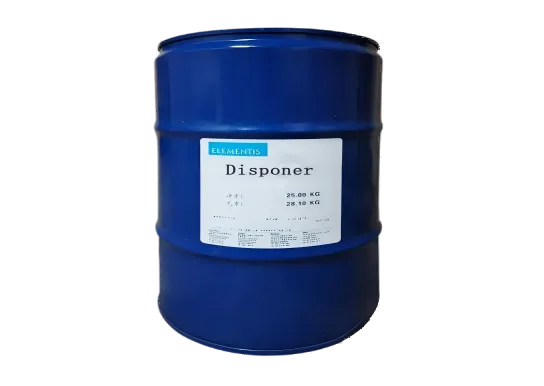
Elementis Deqian Disponer W-19 is a special non-ionic low-foaming wetting dispersant for aqueous systems under Elementis Deqian, specially designed for the optimization of wetting, penetration and color development of aqueous coatings, inks and other systems. Its core advantage is low foaming property, which can completely avoid the negative effects caused by foaming and foam stabilization of ordinary wetting agents
Low foam without negative effects - Extremely low foaming property, eliminating coating defects caused by foaming and foam stabilization of ordinary wetting agents
Excellent wetting and penetration - Quickly wets substrates and pigments, improves system penetration ability, and enhances coating uniformity
Outstanding color development effect - Optimizes pigment color development, improves compatibility between color paste and base paint, and reduces floating color and blooming
Environmentally compliant formula - Free of APEs, meets environmental standards, suitable for the preparation of environmentally friendly aqueous products
Full active and easy to operate - 100% non-volatile content, can be added at any stage of production, just stir evenl
Water-soluble coatings - Various water-soluble architectural and industrial coatings, optimize inorganic pigment dispersion
Hole glue paint - Hole glue paint system, improve construction operability and coating flatness
Water-based inorganic pigment color pastes - Preparation of water-based inorganic pigment color pastes, improve color paste stability
Water-based architectural coatings - Water-based interior and exterior wall coatings, optimize inorganic pigment dispersion and color development
Water-based industrial protective coatings - Water-based industrial protective coatings, improve water resistance and dispersion effect
| Model | Disponer W-19 |
| Brand | Elementis Deqian |
| Chemical Type | Aqueous non-ionic low-foaming wetting and dispersing agent |
| Chemical Composition | Non-ionic surfactant |
| Appearance (25°C) | Amber clear to slightly turbid liquid |
| Non-volatile Content | Approx. 100% |
| Specific Gravity (25°C) | Approx. 0.975 |
| pH Value (25°C) | 6-8 (5% aqueous solution) |
| Cloud Point (25°C) | 27-33°C (1% aqueous solution) |
| Ionicity | Non-ionic |
Q1: What types of pigment systems is Disponer W-19 especially effective for?
A: Disponer W-19 is particularly effective for wetting and dispersing inorganic pigments such as titanium dioxide, iron oxides, and carbon black, as well as many organic pigments commonly used in water-based architectural coatings, industrial finishes, and ink formulations.
Q2: How does Disponer W-19 contribute to formulation stability?
A: It enhances colloidal stability by reducing interfacial tension and providing steric stabilization, helping to prevent pigment agglomeration, settling, and viscosity drift during storage—especially in low-VOC and high-solids aqueous systems.
Q3: Can Disponer W-19 be used in combination with other surfactants or dispersants?
A: Yes, Disponer W-19 is generally compatible with common anionic, nonionic, and polymeric dispersants, and can be used synergistically in hybrid dispersion systems—though compatibility testing under actual formulation conditions is recommended to optimize performance.
Q4: Is Disponer W-19 suitable for low-foaming applications?
A: Yes, it is formulated to provide efficient wetting with inherently low foaming characteristics, making it appropriate for high-shear processes and applications where foam control is critical—such as roller-applied paints and automated coating lines.
Q5: What is the typical dosage range for Disponer W-19 in pigment pastes?
A: Dosage depends on pigment type, loading, and desired performance, but it is typically used at low concentrations—generally ranging from 0.1% to 2% by weight relative to pigment solids—with optimal levels determined through lab-scale dispersion trials.
Contact With Us:
E-mail: wangxingqiang@ericwchem.com
Have a Questions? Call Us:
Add:
Building A1, Jiete Industrial Park, Huangpu District, Guangzhou City, Guangdong Province, China