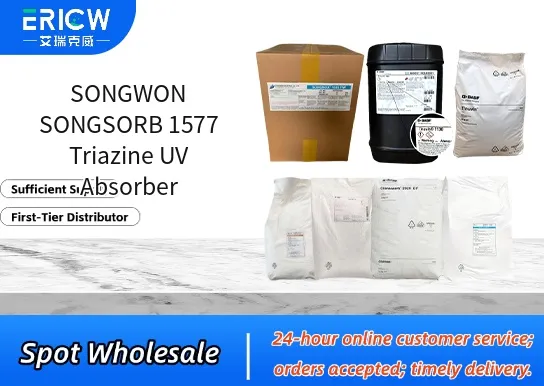
Features Of SONGWON SONGSORB 1577 Triazine UV Absorber
Highly effective broad-spectrum UV absorption in the 290–400 nm range, with peak performance in the critical UVA region.
Exceptional thermal and hydrolytic stability, ensuring long-term performance during high-temperature processing and outdoor exposure.
Low volatility and minimal migration, providing durable protection in demanding polymer applications.
Excellent compatibility with polyolefins, engineering plastics, and thermoplastic elastomers without compromising mechanical properties.
Non-discoloring and chemically inert, maintaining clarity and color stability in transparent and light-colored formulations.
Typical Applications Of SONGWON SONGSORB 1577 Triazine UV Absorber
Polypropylene (PP) fibers and nonwovens for geotextiles, agricultural covers, and automotive interior components.
Polyethylene (PE) films used in greenhouse covers, mulch films, and packaging requiring extended UV resistance.
Automotive exterior parts including bumpers, trim, and under-hood components exposed to intense sunlight and heat.
Outdoor construction materials such as decking, fencing, and cladding profiles based on wood-plastic composites (WPC).
Thermoplastic elastomer (TPE) seals, gaskets, and soft-touch surfaces requiring weatherability and surface integrity.
Specifications Of SONGWON SONGSORB 1577 Triazine UV Absorber
| Chemical Type | Triazine-based UV absorber |
| Product Form | Free-flowing light yellow to pale beige powder |
| Appearance | Free-flowing crystalline powder |
| Molecular Weight (approx.) | 643 g/mol |
| Melting Point | 210–215 °C (DSC) |
| Solubility | Insoluble in water; soluble in common organic solvents (e.g., chloroform, THF, hot xylene) |
| Primary Applications | Polyolefins, engineering plastics, thermoplastic elastomers, WPC |
| Key Features | Broad-spectrum UV absorption, low volatility, high thermal stability |
SONGWON SONGSORB 1577 Triazine UV Absorber – Frequently Asked Questions (FAQ)
Q1: What is the primary mechanism of UV protection offered by SONGSORB 1577?
A: SONGSORB 1577 functions as a highly efficient triazine-based UV absorber that primarily absorbs harmful UV radiation in the 290–400 nm range and dissipates it as low-level heat, thereby preventing photochemical degradation of polymers and coatings.
Q2: In which polymer systems is SONGSORB 1577 most commonly used?
A: It is widely applied in engineering thermoplastics such as polyamide (PA), polybutylene terephthalate (PBT), and polycarbonate (PC), as well as in high-performance coatings and adhesives where long-term UV stability and thermal resistance are critical.
Q3: How does SONGSORB 1577 compare to benzotriazole- or benzophenone-type UV absorbers in terms of performance?
A: As a triazine derivative, SONGSORB 1577 offers superior molar absorption coefficient, enhanced photostability under intense UV exposure, and improved compatibility with polar engineering resins—often resulting in longer service life and reduced tendency for bloom or extraction compared to conventional UV absorbers.
Q4: What is the typical dosage range for SONGSORB 1577 in polymer applications?
A: Dosage depends on formulation requirements, UV exposure conditions, and substrate thickness, but it is typically used at low concentrations—generally ranging from 0.1% to 2% by weight—optimized through application-specific testing.
Q5: Is SONGSORB 1577 suitable for use in food-contact or medical-grade polymer applications?
A: SONGSORB 1577 is not pre-approved for direct food-contact or medical device applications under major global regulatory frameworks; its use in such contexts requires full compliance evaluation—including migration testing and regulatory submission—by the end-user formulator.
 English
 Español
 tiếng việt
 русский