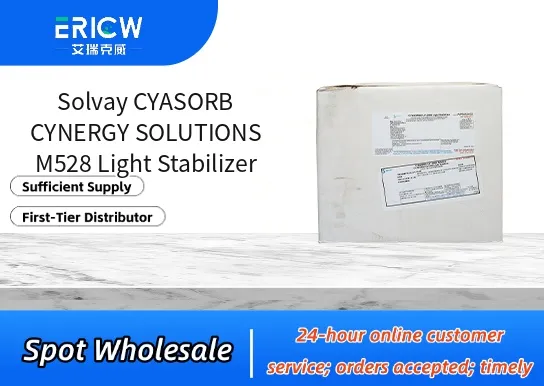
Features Of Solvay CYASORB CYNERGY SOLUTIONS M528 Light Stabilizer
Synergistic HALS–UV absorber blend delivering superior long-term UV protection in demanding outdoor applications.
Enhanced thermal and hydrolytic stability for reliable performance during high-temperature processing (e.g., extrusion, injection molding).
Low volatility and excellent compatibility with polyolefins, engineering thermoplastics, and elastomers.
Reduces surface blooming and improves color retention under prolonged UV exposure.
Designed to meet stringent regulatory requirements including FDA 21 CFR §178.2010 for food-contact plastics (when used as directed).
Typical Applications Of Solvay CYASORB CYNERGY SOLUTIONS M528 Light Stabilizer
Agricultural films (mulch, greenhouse, silage) requiring extended UV durability and mechanical integrity.
Automotive exterior components including bumpers, trim, and under-hood parts exposed to intense sunlight and thermal cycling.
Geotextiles and civil engineering membranes used in outdoor infrastructure projects.
Packaging films for premium consumer goods where aesthetics and shelf-life stability are critical.
Rotomolded polyethylene tanks and containers for water storage and chemical handling.
Specifications Of Solvay CYASORB CYNERGY SOLUTIONS M528 Light Stabilizer
| Chemical Type | Synergistic blend of hindered amine light stabilizer (HALS) and benzotriazole-type UV absorber |
| Product Form | Pellets |
| Appearance | Off-white to light beige free-flowing pellets |
| Primary Applications | Polyolefins (PP, HDPE, LDPE), engineering thermoplastics (PA, PBT), TPOs, and thermoplastic elastomers |
| Key Features | High synergistic efficiency, low extractability, excellent melt stability |
| Benefits | Extended service life, reduced photo-oxidative degradation, improved gloss and tensile retention |
| Processing Compatibility | Stable up to 280 °C for short residence times; suitable for extrusion, injection molding, and blow molding |
| Regulatory Status | Compliant with EU REACH; listed on US TSCA Inventory; meets FDA 21 CFR §178.2010 (food-contact use) |
Solvay CYASORB CYNERGY SOLUTIONS M528 Light Stabilizer – Frequently Asked Questions (FAQ)
Q1: What is the primary function of CYASORB CYNERGY SOLUTIONS M528 in polymer formulations?
A: CYASORB CYNERGY SOLUTIONS M528 is a high-performance light stabilizer designed to protect polymers against photo-oxidative degradation caused by UV radiation and visible light. It combines synergistic HALS (hindered amine light stabilizer) and UV absorber functionalities to provide enhanced long-term weatherability, particularly in demanding outdoor applications.
Q2: Which polymer systems is M528 especially suited for?
A: M528 demonstrates excellent compatibility and performance in polyolefins—including PP and HDPE—as well as engineering thermoplastics such as ABS, PC/ABS blends, and styrenic systems. Its liquid formulation enhances dispersion and processing stability during extrusion or injection molding.
Q3: How does the liquid format of M528 benefit manufacturing processes?
A: As a ready-to-use liquid solution, M528 eliminates handling challenges associated with solid stabilizers—such as dust generation, poor dispersion, and feeding inconsistencies. It enables precise metering, improves homogeneity in masterbatches, and supports cleaner, more efficient compounding operations.
Q4: Is M528 suitable for applications requiring regulatory compliance for indirect food contact?
A: While M528 is not intended for direct food contact, it may be considered for certain indirect food contact applications where permitted under applicable regional regulations. Formulators should consult current regulatory guidelines and conduct full compliance assessments based on final product composition and intended use conditions.
Q5: What is the typical dosage range for effective stabilization with M528?
A: Dosage depends on polymer type, processing conditions, and end-use exposure requirements, but M528 is typically used at low concentrations—generally ranging from 0.1% to 2% by weight—optimized through application-specific testing and performance evaluation.
 English
 Español
 tiếng việt
 русский