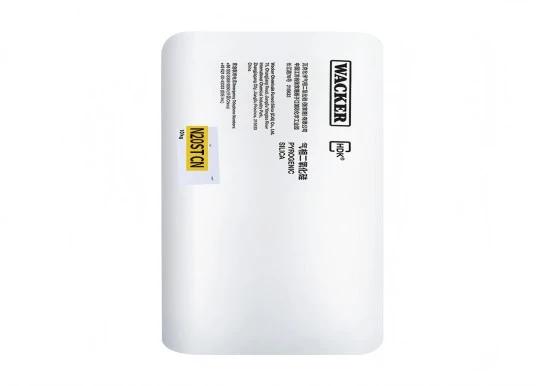
Features Of WACKER Fumed Silica HDK
Surface Modification: Hydrophobic or hydrophilic treatments (e.g., HMDS, DDS) for tailored water resistance and compatibility
Rheology Control: Provides thixotropic behavior, anti-settling, and viscosity stabilization in liquid systems (e.g., coatings, adhesives)
Reinforcement: Enhances mechanical strength in silicone rubber (HTV/LSR), composites, and polymers while maintaining optical clarity
High Purity & Consistency: Synthetic amorphous silica with controlled particle size (nano-scale)
Multi-Functionality: Acts as flow aid, anti-blocking agent, and catalyst support across formulations
Typical Applications of WACKER Fumed Silica HDK
Coatings & Inks: Improves pigment stability, anti-sagging, and corrosion resistance in epoxy/polyurethane systems
Silicone Rubber: Reinforces HTV/LSR with high transparency and tensile strength
Adhesives & Sealants: Optimizes thixotropy and cohesion in polyurethane, epoxy, and STP formulations
Cosmetics & Personal Care: Provides matting, oil absorption, and texture enhancement in sunscreens/makeup
Specifications Of WACKER Fumed Silica HDK
| Model | BET Surface Area (m²/g) | pH Value | SiO₂ Content (%) | Type | Resistivity (Ω·cm) |
| HDK T40 | 400±40 | 3.8-4.3 | 99.8 | Hydrophilic | >10¹³ |
| HDK H17 | 90 (hydrophobic), 130-170 (hydrophilic) | 4.0-6.8 | >99.8 | Hydrophobic | >10¹³ |
| HDK H2000 | 125-175 (hydrophilic), 170-230 (hydrophobic) | 6.5-8.0 | >99.8 | Hydrophobic | >10¹³ |
| HDK H15 | ~120 (hydrophobic) | / | >99.8 | Hydrophobic | >10¹³ |
| HDK H18 | ~120 (hydrophobic), 170-230 (hydrophilic) | / | >99.8 | Hydrophobic | >10¹³ |
| Model | BET Surface Area (m²/g) | pH of 4% Dispersion | Silica Content (%) |
| N20ST | 170-230 | 3.8-4.3 | >99.8% |
| N20P | 170-230 | 3.8-4.3 | >99.8% |
| N20D | 150-230 | 3.8-4.3 | >99.8% |
| V15 | ca.120 | 3.8-4.3 | >99.8 |
| N20 | 170-235 | 3.8-4.3 | >99.8% |
WACKER Fumed Silica HDK – Frequently Asked Questions (FAQ)
Q1: What is the primary functional role of WACKER Fumed Silica HDK in liquid systems?
A: WACKER Fumed Silica HDK acts primarily as a rheology modifier and thickener, providing thixotropic behavior, anti-sagging properties, and improved suspension stability in coatings, adhesives, sealants, and inks.
Q2: How does HDK differ from precipitated silica in terms of performance and application?
A: Unlike precipitated silica, HDK fumed silica has a much higher specific surface area and forms a three-dimensional network via hydrogen bonding, delivering superior reinforcement, viscosity control, and transparency retention—especially in clear systems like silicone elastomers and high-performance coatings.
Q3: Is HDK suitable for use in silicone-based formulations?
A: Yes, HDK grades are widely used as reinforcing fillers in high-consistency and liquid silicone rubber (HCR/LSR), enhancing mechanical strength, tear resistance, and processing stability without compromising cure kinetics.
Q4: What is the recommended approach for dispersing HDK effectively in a formulation?
A: Efficient dispersion typically requires high-shear mixing or pre-wetting with a compatible carrier liquid. Dry blending prior to addition into the main phase helps avoid agglomeration, and deaeration may be needed to eliminate entrapped air due to its low bulk density.
Q5: Can HDK be used in food-contact or pharmaceutical applications?
A: Certain HDK grades are manufactured and certified for use in food-contact materials and pharmaceutical excipients, subject to compliance with applicable regional regulatory frameworks and appropriate grade selection—consult WACKER’s technical documentation and safety data sheets for authorized applications.
 English
 Español
 tiếng việt
 русский