English
 Español
 tiếng việt
 русский
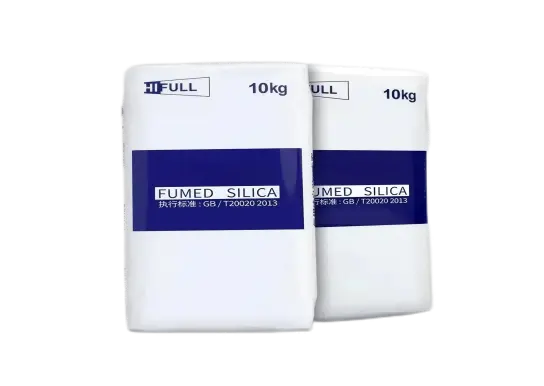
HIFULL White Carbon Black HB engineered through advanced surface modification with HMDS, this high-performance alumina series combines ultra-high purity (>99.99%) with nano-engineered morphology for tailored functionality across industrial applications. The hydrophobic surface treatment minimizes moisture absorption while enhancing compatibility with non-polar matrices like silicone rubber and organic coatings.
Its aggregated nanoarchitecture (BET 270 m²/g) provides robust mechanical reinforcement, improving tensile strength in HTV/LSR elastomers and transparency in optical-grade silicones.
The series excels in rheology modulation, delivering shear-thinning behavior to prevent sagging in vertical coatings and stabilize pigment dispersion in solvent-based inks.
Enhanced Hydrophobicity: Surface-treated for superior water resistance and reduced moisture absorption.
High Surface Activity: Nano-scale structure with high surface area for effective reinforcement.
Rheology Control: Provides stable thixotropy and viscosity adjustment in organic systems.
High Purity: Ultra-low impurity levels for demanding industrial applications.
Improved Processability: Ensures rapid and uniform dispersion in various matrices.
Silicone Rubber: Reinforces HTV/LSR formulations while maintaining transparency.
Coatings & Inks: Enhances anti-settling, anti-sagging, and flow properties.
Defoamers: Optimizes air release efficiency in industrial processes.
Carbon Powder/Toner: Improves flowability and stability in powder-based applications.
| Model | BET Surface Area (m²/g) | Primary Particle Size (nm) | pH Value (Aqueous Dispersion) | Surface Treatment |
| HL-150 | ~150 | ~12 | 3.7-4.7 | Hexamethyldisilazane (HMDS) |
| HL-200 | ~200 | ~7 | 3.5-4.5 | Hexamethyldisilazane (HMDS) |
| HB-630 | 270 ± 30 | ~7 | 6.0-9.0 | Hexamethyldisilazane (HMDS) |
| HB-612 | 270 ± 30 | ~7 | 6.0-9.0 | Hexamethyldisilazane (HMDS) |
| HB-620 | 270 ± 30 | ~7 | 6.0-9.0 | Hexamethyldisilazane (HMDS) |
| HB-152 | 270 ± 30 | ~7 | 6.0-9.0 | Hexamethyldisilazane (HMDS) |
| HB-615 | 270 ± 30 | ~7 | 6.0-9.0 | Hexamethyldisilazane (HMDS) |
| HB-139 | 270 ± 30 | ~7 | 6.0-9.0 | Hexamethyldisilazane (HMDS) |
| HB-135 | 270 ± 30 | ~7 | 6.0-9.0 | Hexamethyldisilazane (HMDS) |
| HB-132 | 270 ± 30 | ~7 | 6.0-9.0 | Hexamethyldisilazane (HMDS) |
Q1: What is the primary functional role of HIFULL White Carbon Black HB in polymer systems?
A: HIFULL White Carbon Black HB serves primarily as a reinforcing filler and viscosity modifier, enhancing mechanical strength, dimensional stability, and processing rheology—especially in silicone rubber, thermoplastic elastomers, and specialty coatings.
Q2: How does HIFULL White Carbon Black HB differ from conventional fumed silica in terms of surface treatment and dispersion behavior?
A: Unlike many untreated fumed silicas, HB is specifically engineered with a controlled hydrophobic surface treatment, enabling easier dispersion in non-polar media and improved compatibility with organic polymers—reducing agglomeration and minimizing mixing energy requirements.
Q3: Is HIFULL White Carbon Black HB suitable for use in high-temperature vulcanized (HTV) silicone rubber formulations?
A: Yes, HB is widely used in HTV silicone rubber applications due to its thermal stability and ability to maintain reinforcement performance across extended curing cycles at elevated temperatures without significant degradation or discoloration.
Q4: What are typical dosage guidelines when incorporating HIFULL White Carbon Black HB into elastomeric compounds?
A: Dosage depends on formulation requirements and target properties, but it is typically used at low concentrations—generally ranging from 0.1% to 2% by weight—to achieve optimal reinforcement without compromising processability or final elasticity.
Q5: Does HIFULL White Carbon Black HB require special handling or pre-treatment before compounding?
A: While no mandatory pre-treatment is required, gentle drying prior to use is recommended if moisture exposure has occurred—particularly for moisture-sensitive systems. Standard industrial mixing equipment (e.g., two-roll mills, internal mixers) is generally sufficient for uniform incorporation.
Contact With Us:
E-mail: wangxingqiang@ericwchem.com
Have a Questions? Call Us:
Add:
Building A1, Jiete Industrial Park, Huangpu District, Guangzhou City, Guangdong Province, China