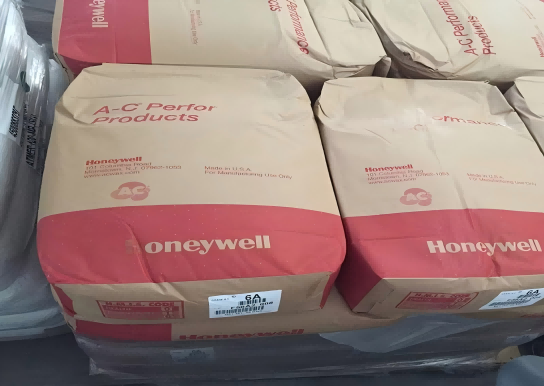
Features Of Honeywell Acrylic-Maleic Anhydride Copolymer Wax Powder A-C 950P
High Grafting Efficiency: Patented technology achieves >50% maleic anhydride incorporation for optimal polarity
Adhesion Enhancement: Improves bonding in aqueous systems and polar substrates via grafted MAH groups
Thermal Resistance: Stable up to 149°C (300°F), outperforming conventional wax additives
Aqueous Compatibility: Excels in water-based formulations for adhesives and coatings
Oxidation Stability: Grafted structure prevents polymer degradation in harsh environments
Versatile Use: Suitable for cables, plastic composites, and industrial adhesives
Typical Applications Of Honeywell Acrylic-Maleic Anhydride Copolymer Wax Powder A-C 950P
Adhesives: Enhances bonding in aqueous/hot melt adhesives for packaging and textiles
Cable & Plastic Modification: Acts as coupling agent for mineral-filled composites
Coatings: Boosts adhesion and scratch resistance in water-based coatings
Industrial: Solutions for inks, textile treatments, and sealants
Specifications Of Honeywell Acrylic-Maleic Anhydride Copolymer Wax Powder A-C 950P
Hardness, dmm (ASTM D-5) | <0.5 |
Viscosity (@190°C) | 2000 |
Drop Point | 149°C(300°F) |
Density | 0.93 |
Product Form | Pellet |
Product Type | MAPP Copolymer |
FDA Non-Food Contact Approval | Yes |
Honeywell Acrylic-Maleic Anhydride Copolymer Wax Powder A-C 950P – Frequently Asked Questions (FAQ)
Q1: What is the primary functional role of A-C 950P in coating and ink formulations?
A: A-C 950P functions primarily as a matting agent and surface modifier, providing controlled gloss reduction, improved scratch resistance, and enhanced slip characteristics without significantly compromising film clarity or adhesion.
Q2: How does A-C 950P differ from conventional polyethylene or Fischer-Tropsch wax powders?
A: Unlike saturated hydrocarbon waxes, A-C 950P contains reactive maleic anhydride groups that enable stronger interfacial interaction with polar resins and pigments—leading to improved dispersion stability, reduced bloom, and better integration into acrylic, polyester, and epoxy-based systems.
Q3: Is A-C 950P suitable for use in waterborne systems?
A: Yes, A-C 950P can be incorporated into waterborne coatings and inks, though optimal performance typically requires pre-dispersion using high-shear mixing or stabilization with compatible surfactants or dispersants to ensure uniform distribution and prevent agglomeration.
Q4: What is the typical dosage range for A-C 950P in industrial coatings?
A: Dosage is formulation-dependent, but A-C 950P is generally used at low concentrations—typically ranging from 0.1% to 2% by weight of the total formulation—to achieve desired matting and surface effects while maintaining rheology and film integrity.
Q5: Does A-C 950P require thermal activation or post-application curing to develop its full functionality?
A: No special thermal activation is required; the wax particles migrate and orient at the film surface during standard drying or ambient cure conditions. However, full surface expression and optimal performance are generally realized after complete solvent evaporation or crosslinking completion.
 English
 Español
 tiếng việt
 русский