English
 Español
 tiếng việt
 русский
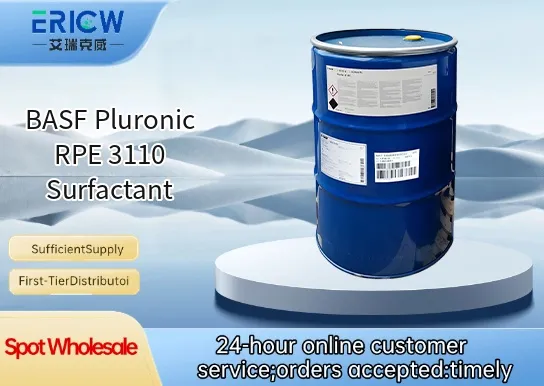
Nonionic triblock copolymer based on propylene oxide (PO) and ethylene oxide (EO) with reverse PEO–PPO–PEO architecture.
Excellent thermal stability and low-temperature solubility profile, enabling robust performance across wide processing conditions.
Low foaming characteristics ideal for high-shear industrial cleaning and formulation systems.
Highly effective wetting and surface tension reduction in aqueous systems without compromising biocompatibility.
REACH-compliant and registered under TSCA; suitable for use in regulated industrial and institutional applications.
Industrial hard-surface cleaners and disinfectant formulations.
Agrochemical adjuvants for enhanced active ingredient dispersion and foliar uptake.
Oilfield demulsifiers and pipeline flow improvers in enhanced oil recovery (EOR) systems.
Textile auxiliaries for dye leveling and uniform wetting during pretreatment.
Pharmaceutical excipient in solubilization and stabilization of poorly water-soluble APIs.
| Chemical Type | Nonionic triblock copolymer (reverse PEO–PPO–PEO) |
| Product Form | Pale yellow to amber viscous liquid |
| Appearance | Clear to slightly hazy, homogeneous liquid at 25°C |
| Primary Applications | Cleaning, agrochemicals, oilfield chemicals, textiles, pharmaceuticals |
| Key Features | Low foaming, thermally stable, excellent wetting, REACH-compliant |
| Benefits | Improved formulation efficiency, reduced rinse requirements, broad compatibility with electrolytes and surfactants |
| pH (1% aqueous solution) | 6.0 – 7.5 |
| Cloud Point (1% aqueous solution) | ~78–82°C |
Q1: What is the primary functional role of Pluronic RPE 3110 in formulations?
A: Pluronic RPE 3110 is a nonionic triblock copolymer surfactant designed primarily for emulsification, solubilization, and stabilization of oil-in-water systems. Its balanced hydrophilic-lipophilic character supports performance in demanding applications such as agrochemical concentrates, industrial cleaning, and specialty coatings.
Q2: How does Pluronic RPE 3110 compare to other Pluronic grades in terms of cloud point and temperature sensitivity?
A: Pluronic RPE 3110 exhibits a moderate cloud point—higher than low-EO variants like L-series but lower than high-EO grades such as F127—making it suitable for ambient-to-warm process conditions without premature phase separation. Its performance remains stable across typical formulation and storage temperatures encountered in industrial use.
Q3: Is Pluronic RPE 3110 compatible with common electrolytes and acidic or alkaline media?
A: Yes, this surfactant demonstrates good tolerance to moderate concentrations of salts and maintains functionality across a broad pH range (approximately pH 3–11), supporting its use in formulated systems containing fertilizers, corrosion inhibitors, or pH-adjusted cleaners.
Q4: What are typical dosage ranges for Pluronic RPE 3110 in commercial formulations?
A: Dosage depends on formulation requirements and target performance, but it is typically used at low concentrations—generally ranging from 0.1% to 2% by weight—in emulsion concentrates, solubilizing aids, and wetting agents.
Q5: Can Pluronic RPE 3110 be used in food-contact or pharmaceutical applications?
A: Pluronic RPE 3110 is not intended for direct food contact or pharmaceutical use. It is formulated and qualified for industrial, agricultural, and technical applications. Customers requiring regulatory-compliant surfactants for sensitive end uses should consult BASF’s portfolio of food-grade or pharma-qualified Pluronic grades.
Contact With Us:
E-mail: wangxingqiang@ericwchem.com
Have a Questions? Call Us:
Add:
Building A1, Jiete Industrial Park, Huangpu District, Guangzhou City, Guangdong Province, China