English
 Español
 tiếng việt
 русский
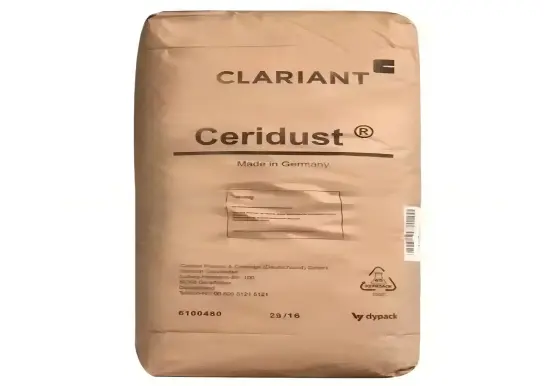
The Clariant Ceridust Wax powder series comprises advanced micronized wax additives engineered to elevate performance across coatings, plastics, and industrial inks. These PTFE-modified and polar-functionalized polyethylene/polypropylene waxes deliver low-friction surfaces, exceptional abrasion resistance, and optimized processing efficiency. Their ultra-fine particle distribution ensures seamless integration into solvent-based, water-based, and powder systems, enhancing scratch resistance while minimizing metal marking and block tendencies.
reduces surface defects, and extends product longevity. Compatible with diverse formulation systems, they are widely adopted in automotive coatings, industrial plastics, and high-quality printing inks. Regulatory compliance (FDA/CLP) and tailored compatibility further solidify their role as versatile, high-performance additives for modern manufacturing challenges.
Superior scratch and wear resistance for extended coating durability and lifespan,Advanced friction reduction technology for improved surface sliding and tactile smoothness.
Optimized dispersibility for uniform distribution in powder coatings and solvent/water-based systems,micronized particle technology ensures seamless integration and ease of application.
Balanced anti-blocking and slip properties for storage stability and handling ease,djustable matting effects (low to high gloss) to meet diverse aesthetic requirements.
Eco-friendly formulations compliant with international safety and non-toxic standards,wide compatibility with solvent-based, water-based, and powder coating systems.
Enhanced surface gloss and smoothness for superior visual and tactile appeal,reduced metal marking and improved coating uniformity for high-end finishes.
Protects metal, wood, and composite surfaces with enhanced wear resistance and gloss retention.
Improves scratch resistance and smoothness for household and decorative applications.
Boosts abrasion resistance and slip performance in solvent/water-based inks for high-quality prints.
Acts as a multifunctional additive to reduce friction and improve mold release in polymer products.
Adaptable to automotive, electronics, and optical coatings for tailored surface properties.
| Model Number | Chemical Type | Appearance | Drop Point [℃] | Density [g/cm³] |
| Ceridust 8330 TP | Micronized Wax Compound | White Powder | ~102 | ~1.02 (23°C) |
| Ceridust 3251 | Micronized Wax Compound | White Powder | ~102 | ~1.02 (23°C) |
| Ceridust TP6721 | Amide-modified Polypropylene | White Powder | ~155 | ~0.99 (20°C) |
| Ceridust 3716 | Polar Modified Polyethylene Wax | Micronized Wax Powder | / | / |
| Ceridust 9322F | / | White Powder | ~124 | ~1.02 (20°C) |
| Ceridust 3920 F | PTFE-modified Polyethylene Wax | White Micronized Powder | / | 1.00-1.03 (23°C) |
| Ceridust 9615A | Modified Polyethylene Wax | White Fine Powder | / | / |
| Ceridust 3610 | High-Density Polyethylene Wax | Micronized Powder | / | 0.94 |
| Ceridust 4060 TP | Polar Modified Polyethylene Wax | Slightly Yellow Powder | ~112 | / |
| Ceridust 6050 M | / | White Micronized Powder | 142-148 | ~0.90 (23°C) |
Q1: What are the primary functional benefits of Ceridust wax powder in polymer processing?
A: Ceridust wax powders act as high-performance external lubricants and release agents, improving melt flow, reducing die build-up, enhancing surface gloss, and facilitating demolding—particularly in thermoplastics like PVC, polyolefins, and engineering resins.
Q2: How is Ceridust wax powder typically incorporated into formulations?
A: It is commonly added during dry blending with polymer granules or masterbatch preparation, and can also be introduced via side-feeding in extrusion. Due to its fine, free-flowing powder form, it disperses readily without requiring pre-dilution or melting steps.
Q3: Is Ceridust wax powder suitable for applications requiring food contact compliance?
A: Certain Ceridust grades are manufactured under strict quality controls and may be suitable for indirect food contact applications where regulatory approval is obtained by the end-user. Final compliance depends on the specific grade, dosage, polymer matrix, and applicable regional regulations—consult Clariant’s regulatory documentation and perform application-specific testing.
Q4: How does Ceridust compare to paraffin or PE waxes in terms of thermal stability?
A: Ceridust wax powders—often based on oxidized polyethylene or functionalized polyolefin chemistries—exhibit higher onset decomposition temperatures and better resistance to blooming compared to conventional paraffin or low-molecular-weight PE waxes, supporting stable performance in high-temperature processing such as injection molding and calendering.
Contact With Us:
E-mail: wangxingqiang@ericwchem.com
Have a Questions? Call Us:
Add:
Building A1, Jiete Industrial Park, Huangpu District, Guangzhou City, Guangdong Province, China