English
 Español
 tiếng việt
 русский
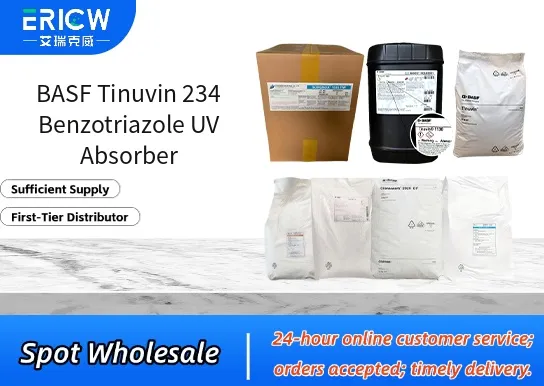
Highly effective UV absorption in the 290–400 nm range, providing broad-spectrum protection against photochemical degradation.
Excellent compatibility with a wide range of polymers including polyolefins, engineering plastics, and coatings.
Good thermal stability up to 250 °C, enabling use in high-temperature processing such as injection molding and extrusion.
Low volatility and minimal migration, ensuring long-term stabilization performance in demanding applications.
Non-discoloring and chemically stable under UV exposure, preserving aesthetic integrity of end products.
Automotive interior parts (e.g., dashboards, trim, and seating components).
Outdoor polymer profiles and building materials (e.g., window frames, cladding, and roofing membranes).
Coatings for industrial and architectural applications requiring weather resistance.
Plastic packaging for UV-sensitive contents, including agricultural films and specialty containers.
Medical device housings exposed to ambient or sterilization-related UV conditions.
| Chemical Type | Benzotriazole-based UV absorber |
| Product Form | Free-flowing crystalline powder |
| Appearance | Off-white to light yellow crystalline solid |
| Molecular Weight | 371.4 g/mol |
| Melting Point | 138–142 °C |
| Solubility | Soluble in common organic solvents (e.g., chloroform, THF, hot toluene); insoluble in water |
| Primary Applications | Polyolefins, PVC, ABS, polycarbonate, coatings, adhesives |
| Key Features | UV absorption peak at ~340 nm; low volatility; hydrolytic stability |
Q1: What are the primary application areas for Tinuvin 234?
A: Tinuvin 234 is widely used in transparent or lightly pigmented polymer systems requiring long-term UV stability, especially in polycarbonate, ABS, polyesters, and acrylics. It is commonly selected for outdoor applications such as automotive interior parts, construction glazing, lighting covers, and consumer electronics housings where clarity and resistance to yellowing are critical.
Q2: How does Tinuvin 234 compare to other benzotriazole-based UV absorbers in terms of thermal stability and compatibility?
A: Tinuvin 234 offers enhanced thermal stability and superior compatibility with engineering thermoplastics compared to earlier-generation benzotriazoles. Its molecular structure supports good dispersion and reduced volatility during high-temperature processing, making it suitable for extrusion and injection molding without significant degradation or plate-out issues.
Q3: Is Tinuvin 234 suitable for food-contact or medical-grade polymers?
A: Tinuvin 234 is not generally approved for direct food-contact applications under major global regulatory frameworks. For medical or sensitive end-use applications, formal regulatory assessment—including compatibility testing and migration evaluation—must be conducted by the compounder or end-user in accordance with applicable regional requirements.
Q4: What is the typical dosage range for effective UV protection?
A: Effective performance is typically achieved at low concentrations, generally ranging from 0.1% to 2% by weight, depending on polymer type, part thickness, exposure conditions, and required service life. Optimal dosage should be determined through application-specific weathering trials and optical property evaluation.
Q5: Can Tinuvin 234 be used in combination with other stabilizers?
A: Yes, Tinuvin 234 is frequently combined with hindered amine light stabilizers (HALS) and/or phosphite antioxidants to provide synergistic protection against photo-oxidative degradation. Compatibility and performance should be verified in the final formulation, particularly when used with acidic additives or certain pigments.
Contact With Us:
E-mail: wangxingqiang@ericwchem.com
Have a Questions? Call Us:
Add:
Building A1, Jiete Industrial Park, Huangpu District, Guangzhou City, Guangdong Province, China