English
 Español
 tiếng việt
 русский
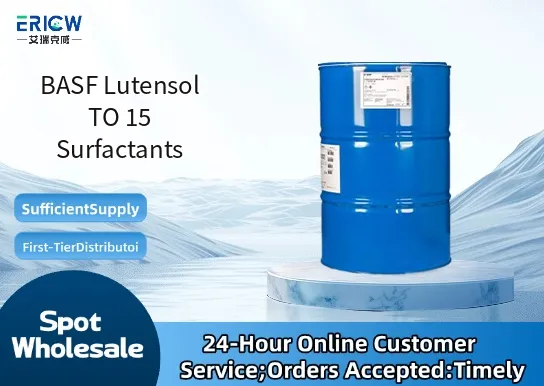
Nonionic surfactant based on linear alcohol ethoxylate (C13–C15) with balanced hydrophilic-lipophilic properties.
Excellent wetting, emulsifying, and solubilizing performance across a broad pH range (pH 4–12).
Low foaming profile suitable for high-shear and industrial cleaning applications.
Good biodegradability (OECD 301B compliant) and favorable ecotoxicological profile.
Stable in hard water and compatible with common anionic, cationic, and amphoteric surfactants.
Industrial and institutional cleaners (I&I), including floor cleaners and degreasers.
Agrochemical formulations — as adjuvant for herbicides, fungicides, and insecticides.
Textile auxiliaries — for scouring, dye leveling, and dispersing agents.
Paints and coatings — as stabilizer and co-emulsifier in acrylic and styrene-butadiene dispersions.
Home care liquid detergents and dishwashing formulations requiring low-foam efficiency.
| Chemical Type | Linear alcohol ethoxylate (C13–C15, ~15 EO units) |
| Product Form | Liquid |
| Appearance | Pale yellow to colorless, clear to slightly hazy liquid |
| pH (1% aqueous solution, 20 °C) | 5.5–7.0 |
| Cloud Point (1% aqueous solution) | 62–68 °C |
| Active Content | 99–100 wt% |
| Density (20 °C) | 1.02–1.04 g/cm³ |
| Viscosity (20 °C) | 200–500 mPa·s |
Q1: What is the primary function of Lutensol TO 15 in industrial formulations?
A: Lutensol TO 15 is a nonionic surfactant based on linear alcohol ethoxylates, primarily used as an emulsifier, solubilizer, and wetting agent in aqueous systems. Its balanced hydrophilic-lipophilic character supports stable oil-in-water emulsions and enhances compatibility across diverse ingredient types.
Q2: Is Lutensol TO 15 suitable for low-temperature applications?
A: Yes — due to its relatively low cloud point and good water solubility at ambient and moderately reduced temperatures, Lutensol TO 15 maintains performance in formulations intended for use or storage below room temperature, though optimal efficacy is typically observed above 5 °C.
Q3: How does Lutensol TO 15 compare to other Lutensol TO grades in terms of hydrophilicity and foaming behavior?
A: As a mid-range ethoxylate (TO 15 indicates ~15 moles of ethylene oxide), it offers higher water solubility and lower foam stability than lower-EO variants like TO 5 or TO 7, while providing greater surface activity and milder foaming than higher-EO grades such as TO 20 or TO 30.
Q4: Can Lutensol TO 15 be used in combination with ionic surfactants?
A: Yes — it is generally compatible with anionic, cationic, and amphoteric surfactants, enabling synergistic effects in mixed systems. However, formulation stability should be verified experimentally, particularly in high-electrolyte or extreme pH environments.
Q5: What are typical dosage ranges for Lutensol TO 15 in cleaning or agrochemical concentrates?
A: Dosage depends on formulation requirements, but it is typically used at low concentrations — generally ranging from 0.1% to 2% by weight — to achieve effective emulsification or solubilization without compromising system clarity or viscosity.
Contact With Us:
E-mail: wangxingqiang@ericwchem.com
Have a Questions? Call Us:
Add:
Building A1, Jiete Industrial Park, Huangpu District, Guangzhou City, Guangdong Province, China